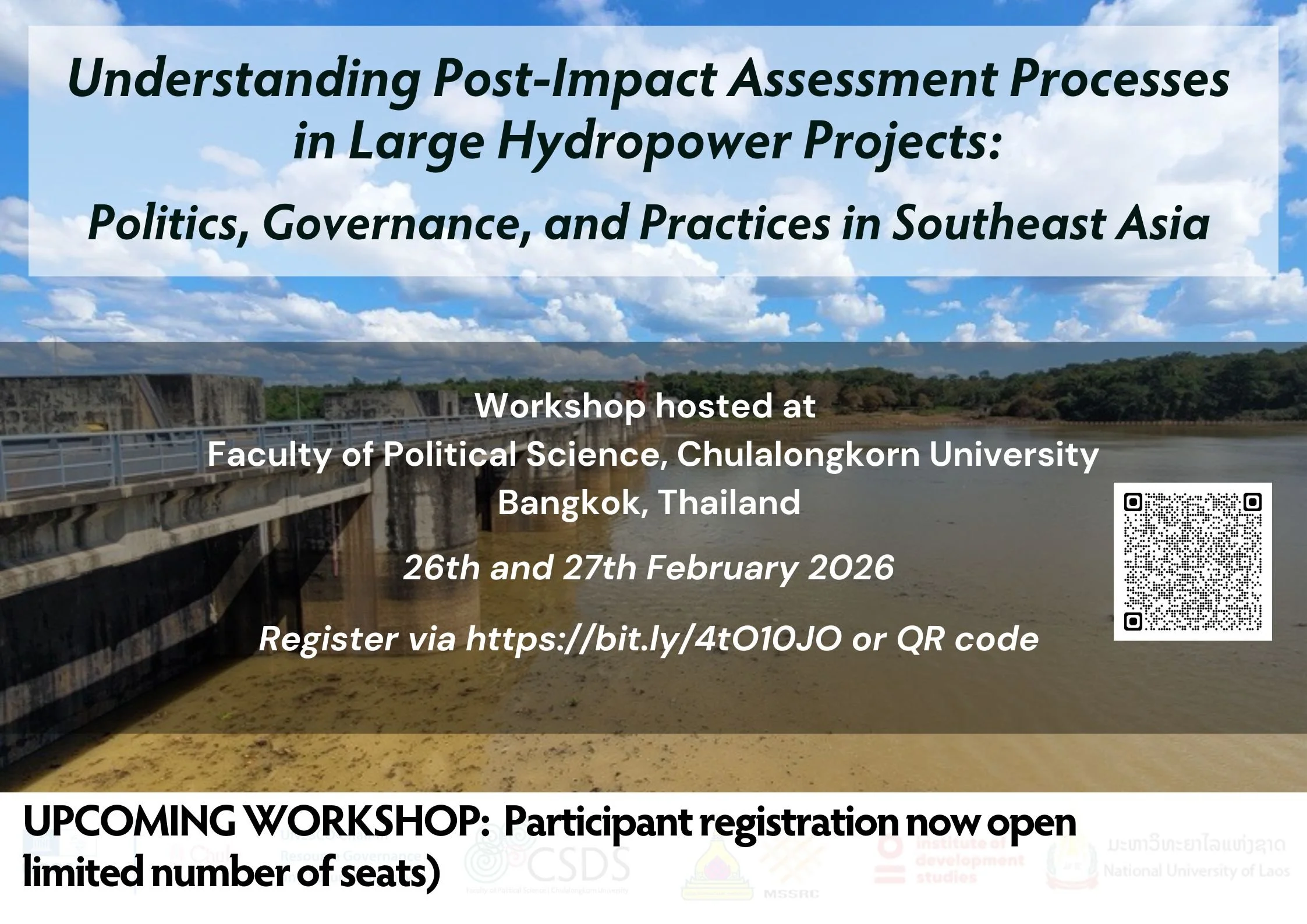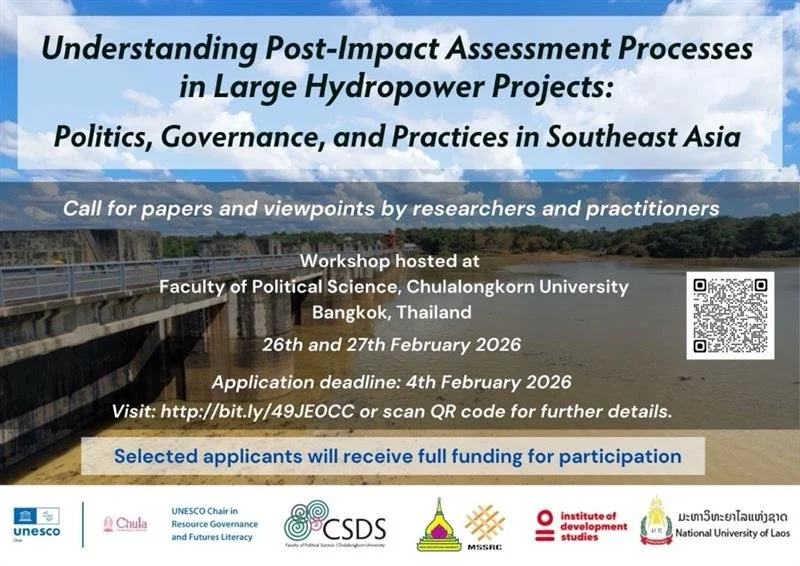
UPCOMING WORKSHOP: Call for papers and viewpoints - Understanding Post-Impact Assessment Processes in Large Hydropower Projects

Further details here

Workshop on Understanding Post-Impact Assessment Processes in Large Hydropower Projects: Politics, Governance, and Practices in Southeast Asia

26th and 27th February 2026

Faculty of Political Science, Chulalongkorn University
Bangkok, Thailand

Deadline for Submission: 4 February 2026

Organized by: Center for Social Development Studies, Chulalongkorn University ; Mekong Sub-region Social research Center, Faculty of Liberal Arts, Ubon Ratchathani University; Faculty of Law and Political Science, and Office of Post Graduate Studies, National University of Laos; and Institute of Development Studies

Introduction:

In Southeast Asia, a growing number of large hydropower dams are in operation. Responding to a rising recognition of the environmental and social impacts of large dams globally and within the region, since the 1990s governments have expanded legal requirements for the preparation of impact assessments (IAs). Early IAs assessed for project-level environmental and social harms, while more recently the scope of IAs have expanded to incorporate cumulative and strategic assessments, as well as issues such health and gender impacts. By identifying harms and risks, and formulating management plans for avoidance and mitigation measures, IAs are intended to generate ‘anticipatory evidence’ to inform and improve decision-making. The policy and practices of impact assessments have in general strengthened since the 1990s, although in some cases have been controversial including in terms of the quality of public participation, disputes over the assessment of potential harms and risks, and conflicts of interest especially between consultants hired to conduct IAs and project proponents, as well as tensions between policies prioritizing economic growth and those on environmental and social protection.

Reflecting the significance attributed to IA in approving large hydropower dams, a considerable body of research and analysis has been produced on how IAs are produced. These includes by practitioners on best/better practices in IA, by civil society on the strengths and shortcoming of IA studies, by impacted communities on the harms experienced or anticipated, and by scholars for example on the politics of knowledge and implications for environmental and social justice. However, there has been less attention to the actual outcomes of IAs for large dams that have proceeded, including whether IAs predictions were accurate and if proposed management plans were implemented and effective. This is a significant gap given both the number of large hydropower dams now in operation across the region, and plans for more in the future.

The objective of this workshop is to bring together researchers and practitioners, including impacted communities and civil society, to assess the actual outcomes, governance, uses of knowledge, and implications for justice of IAs after they have been completed. The workshop aims to strengthen evidence-based approaches reflecting on where IAs have helped, where they have fallen short, and how responsibilities, evidence, and accountability are negotiated over longer periods of time as a project is operated.

Workshop format 
The workshop format will include:  

  • Paper presentation panels: Each selected research paper will be invited to present for fifteen minutes, followed by Q&A 

  • Practitioner presentation panels: Selected practitioner viewpoints will be to present for fifteen minutes, followed by Q&A  

  • Practitioner dialogues: Workshop themes will be discussed on facilitated dialogue panels among selected practitioners. 

  • Community film: A participatory video created about the Pak Mun Dam will be screened, and community members will share their reflections

 The meeting will be held in English, with simultaneous translation to Thai. 

Workshop themes 
We invite papers and viewpoints by researchers and practitioners, including civil society, consultants, policy makers, and project operators, that explore the following themes.  

Assessing outcomes 

  • Looking back, how well did impact assessments reflect what actually happened once projects were built? What impacts were underestimated or missed, and how were these dealt with in practice? 

  • What does post-impact assessment monitoring look like on-the-ground? What types of techniques are used?  

  • How are post-impact assessment processes and outcomes experienced differently by women, men, people with disabilities, older people, and other marginalised groups? Why do these differences persist in the post-IA period? 

  • How have wider changes such as economic shifts, new technologies, climate change, and changing social values, challenged the original assumptions behind impact assessments? How are these changes dealt with, if at all, once projects are already operating? 

 Governance  

  • After a project is operating, who is responsible for monitoring impacts, responding to problems, and paying for solutions? Where are these responsibilities clearly defined (legally; contractually), and where do they become unclear or contested? 

  • How have policy and legal requirements for the monitoring period changed over time? What legal loopholes remain and why? 

 Knowledge  

  • How do the ways evidence is produced during impact assessment shape what is monitored, discussed, or ignored once projects are built? Whose knowledge continues to count in the post-impact period? 

  • When and how does knowledge from communities, civil society, and think tanks actually influence impact assessments and post-impact decisions? Does it make a difference to outcomes on the ground?  

  • What innovations, best practices and ‘better’ practices that improve outcomes in the post-impact assessment period exist in SE Asia and how have they emerged? 

  • Is there a shared regional conversation among researchers and practitioners about post-impact assessment in Southeast Asia? What questions remain unanswered, and what should be prioritised going forward? 

 Justice 

  • How accountable are post-impact processes in practice? How do people raise concerns, seek redress, or make claims through formal channels and informal processes such as dialogue, negotiation, protest, or the media? 

  • What do community claims for unredressed injustices during the impact assessment period continue into the post-impact assessment period? What are lessons learned about what can and should be done?  
 Timeline 

  • Application deadline: 17:00 (ICT) 4th February 

  • Announcement of selected papers and participants: 6th February 

  • Submission of a working draft paper, of between 3000-5000 words: 20th February. Suitable papers will subsequently be invited to prepare a full draft for a international journal Special Issue. 

  • Workshop dates: 26th and 27th (half day) February 

Application process 
Selected researchers and practitioners will be offered full support to join the workshop.  

 For research papers: 

  • Please submit a 300-word abstract, summarizing the proposed paper’s problem statement, research question, argument, details on the case study and any key findings.  

  • Please also include a 150 word author bio. 

  • Note, research papers may be invited to contribute towards a Special Issue in an international academic journal. 

For viewpoints: 

  • Pleases submit a 300 word summary detailing the topic that you would like to share on. Please indicate if you would prefer to make a presentation on your viewpoint or join a dialogue panel. 

  • Please also include a 150 word author bio. 

Submissions and enquiries 
All submissions and enquiries to be addressed to Dr. Carl Middleton: carl.m@chula.ac.th.  

UPCOMING EVENT: ARI E-Workshop on Transboundary Environmental Governance in Southeast Asia [Online, 4 December 2020]

ARIworkshop.jpg

15.40-17.30, Friday, 4 December 2020 via Zoom

Carl Middleton from CSDS will be presenting on this event.

The Asia Research Institute, National University of Singapore, is going to organize an inter-disciplinary workshop on "Transboundary Environmental Governance in Southeast Asia" to explore how, why, when and what forms of transboundary environmental governance are emerging in Southeast Asia.

The workshop will be conducted online via Zoom. To register, please visit this link here and the organizer will reply prior to the event with the Zoom link.

Panel IV. Hybrid Governance of Transboundary Commons

Chairperson: Zu Dienle Tan, National University of Singapore

Panelists:

  • Beyond the Commons/Commodity Dichotomy in the Lancang-Mekong Basin: Implications for Transboundary Water Governance by Carl Middleton, Chulalongkorn University

  • Unruly Fires: Nonhumans as Transboundary Actants in Governing Indonesia’s Wildfires by Rini Astuti, National University of Singapore and Yuti Ariani Fatimah, Nanyang Technological University

  • A Multi-Scalar Political Economy Analysis of Thailand’s Widespread Urban Air Pollution by Danny Marks, Dublin City University

  • Path Dependency of Land Use in Southeast Asian Peatlands by Lahiru Wijedasa, National University of Singapore

Abstract:

Beyond the Commons/Commodity Dichotomy in the Lancang-Mekong Basin: Implications for Transboundary Water Governance

Extensive hydropower construction across the Lancang-Mekong basin is changing the river’s hydrology and ecology, with implications for the availability and governance of common pool resources, as well as for riparian livelihoods. In this paper, I assess how the transboundary commons are being reworked as the river is transformed by large dam operation. The paper applies an analytical lens that seeks to move beyond a commons-commodity dichotomy in water related resource governance (Paerregaard and Andersen, 2019) to argue that at the present time the Lancang-Mekong River is neither fully commodified nor fully a commons, but rather a hybrid of the two. The paper will examine how transboundary hybrid governance regimes are reworking the hybrid commons, drawing attention to how states, communities, and even private actors, seek to maintain particular types of commons, whilst simultaneously either furthering or resisting commodification of some properties of the river. The paper will discuss the implications of this hybrid governance perspective for recent hydropolitics in the river basin and existing and new transboundary water governance institutions, namely the Mekong River Commission and the Lancang-Mekong Cooperation framework.

For more information about this event, please visit the organizer’s webpage here.

UPCOMING WORKSHOP: "2017 Winter School for Young Human Rights Defenders" [10-13 December]

 "Winter School for Young Human Rights Defenders"

10-13 December 2017 at the Faculty of Political Science, Chulalongkorn University, Bangkok, Thailand

Call for Thai participants

Workshop convened by the Center for Social Development Studies, Faculty of Political Science and The May 18 Memorial Foundation (518기념재단) (Gwangju, South Korea)


Join us in our training program for young human rights defenders, especially for those who are keen to be part of the fruitful networking and mature dialogue between the activism field and that of academe of human rights!

This Winter School will be a rare chance for human rights students and young activists to carefully listen to the witnessing voices over the light and darkness of human rights issues from neighbor countries, energetically to unite the strength and wisdom to help the risks/challenges faced by HR defender friends, and to get to know each other not only as young HR comrades but also as friends who care about other human being.

Program includes:

• Special Roundatable dedicated to Jatupat Boonpattaraksa (Pai Dao Din), the Laureate of 2017 Gwangju Prize for Human Rights, facilitated by Asst.Prof. Dr. Pitch Pongsawat

• ”From Gwangju to Bangkok: Lessons Learned from Democratic Movements” by Dr.Kanokrat Lertchoosakul

• ”The Role of Human Rights Organizations in Perpetuating a Culture of Impunity in Thailand” by Assoc.Prof. Dr.Puangthong Pawakapan

• ”Art as a Form of Resistance” by Asst.Prof. Dr.Pandit Chanrochanakit

• Four lectures on Human Rights Situations in South Korea, Malaysia, Nepal and Bangaladesh

• Peer discussion on Human Rights issues with participants from other Asian countries

• Field Visit to Human Rights Defenders w/ Reflection on Judicial System on Political Prisoners in Thailand by Sirikarn Charoensri, The Lawyers for Lawyers Award 2017 Laureate

Interested participants should write a one-page essay reflecting your thoughts and/or experience in human rights issues. Submit the essay to napath_23592@hotmail.com before November 30. 2017.

UPCOMING WORKSHOP: "Stakeholder Conference on “Transdisciplinary Approaches to Migration, Environmental Change, and Social Inequality” [21 and 22 June 2017]

9:00-17:00, Alumni Meeting Room, 12th Floor
Faculty of Political Science, Chulalongkorn University

Co-organized by
the MA in International Development Studies Program, Center for Social Development Studies (CSDS), and the Faculty of Political Science Chulalongkorn University.

Background

Many contemporary development challenges in Southeast Asia are complex and inter-related, including environmental degradation; migration; and social inequality. To appropriately understand these challenges and identify novel insights and innovative solutions, transdisciplinary approaches are required. Not only does this therefore require new research methodologies and new skills for researchers and practitioners, but it also requires universities to develop new curriculum, teaching/ learning materials, and programs.

The Fostering Multi-Lateral Knowledge Networks of Transdisciplinary Studies to Tackle Global Challenges KNOTS project aims to contribute towards meeting this challenge. The three-year project was initiated in October 2016, and is a collaboration between seven universities in Europe, Thailand and Vietnam: the University of Vienna, Austria, which is also the project coordinator; Charles University, Czechia; University of Bonn, Germany; Chulalongkorn University and Chiang Mai University, Thailand; and Ho Chi Minh City Open University, Southern Institute of Social Sciences, and Vietnam Academy of Social Sciences, Vietnam. The project is funded by the European Commission’s ERASMUS+ programme.

Event objectives

The objectives of the Stakeholder Workshop are as follows:

  • To deepen understanding on development challenges in Southeast Asia as viewed through a transdisciplinary lens, focusing on environmental degradation; migration; and social inequality
  • To inform KNOTS project design towards establishing innovative teaching methodologies with contribution from academics and non-academic stakeholders in Southeast Asia
  • To contribute towards establishing a “transdisciplinary knowledge network” on Southeast Asia

UPCOMING WORKSHOP: “Thailand's Sustainable Development Goal 12: Sustainable Consumption and Production (SCP) status” [2 June 2017]

9:00-12:30, Alumni Meeting Room, 12th Floor
Faculty of Political Science, Chulalongkorn University

Co-organized by
the Center for Social Development Studies (CSDS) of the Faculty of Political Science Chulalongkorn University, Thailand
Research Fund, and Faculty of Economics, Thammasart University.

This event will be conducted in Thai language. 


Center for Social Development Studies (CSDS) in collaboration with Thailand Research Fund and Faculty of Economic Thammasart University is glad to invite experts for the Information Sharing Seminar on the “Thailand's Sustainable Development Goal 12: Sustainable Consumption and Production (SCP) status”. The research aims to evaluate the current actions by state as well as non-state actors, in order to provide recommendations for the economic, social and legal measure to further SCP actions. The seminar provides opportunities for the research to gain feedback from SDG experts, and will conduct priority setting workshop for SDG-12 targets. The overall expected outcome of the project will include reviews of literature regarding SCP concepts; status of actions conducted by state agencies, private sector and CSOs; recommendation on actions to enhance Thailand SCP to achieve SDG and improve overall implementation; and priorities within SCP targets to be evaluated. The report will be disseminated to both state and non-state actors for further implementation.

A press article will be produced as the result of the seminar. Read the draft here.

The workshop agenda can be downloaded here.

UPCOMING WORKSHOP: "Chula - Right Livelihood Summer School" [24 July – 7 August, 2015]

UPCOMING WORKSHOP: "Chula - Right Livelihood Summer School" [24 July – 7 August, 2015]

To realize this mission four organizations have prepared to pioneer the co-creation of the international Chulalongkorn University – Right Livelihood Summer School. This is a proposed partnership between Chulalongkorn University and its Master Program in International Development Studies (MAIDS), the Right Livelihood College, and Sathirakoses Nagapradipa Foundation / Suan Nguen Mee Ma social enterprise. The academia – civil society partnership is planned to be inaugurated during the CURLS 2015.

Read More