
UPCOMING WORKSHOP: Open to participant registration - Understanding Post-Impact Assessment Processes in Large Hydropower Projects
/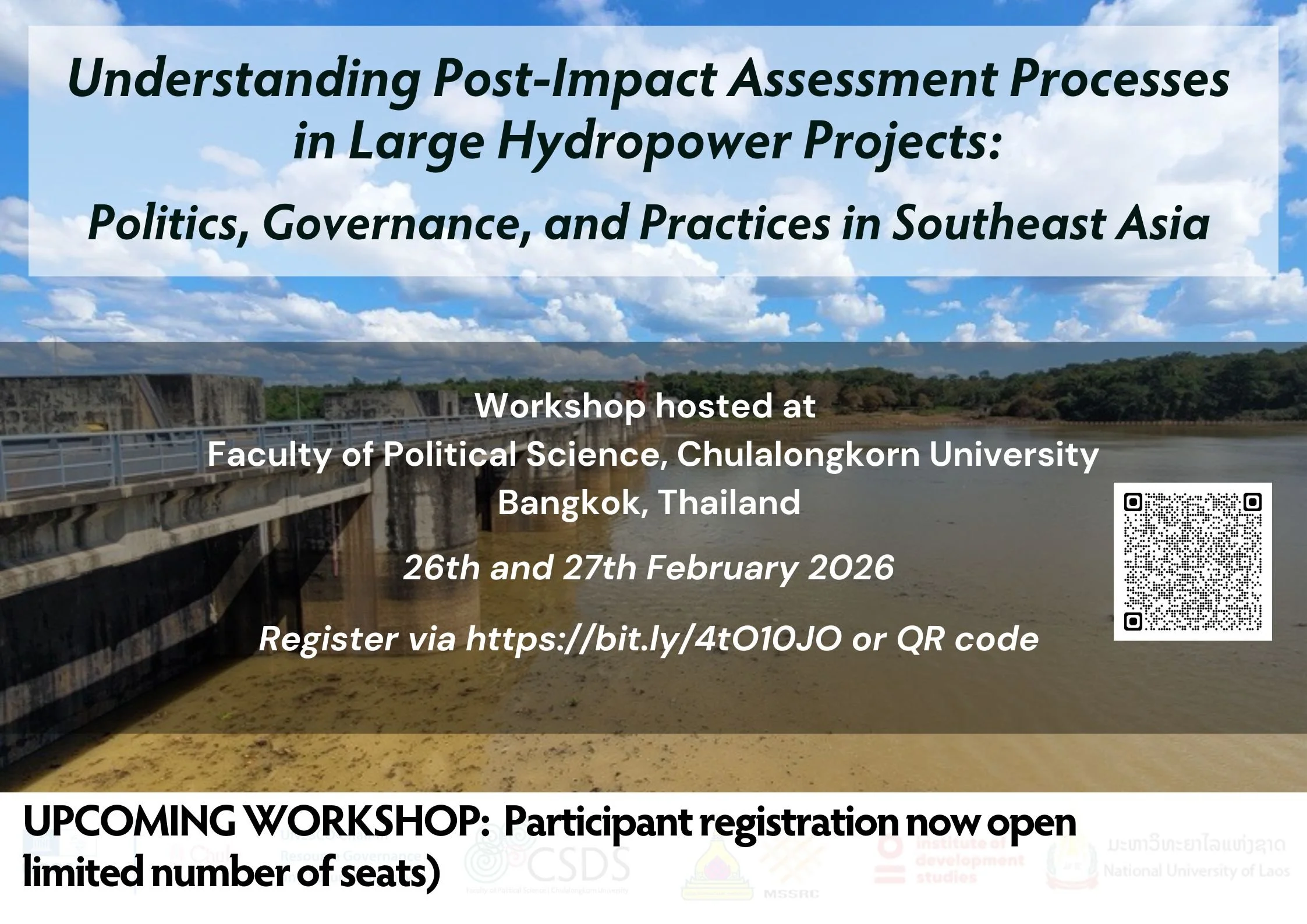
Workshop on Understanding Post-Impact Assessment Processes in Large Hydropower Projects: Politics, Governance, and Practices in Southeast Asia
26th (full day) and 27th (morning) February 2026
Alumni Meeting Room (12th Floor)
Faculty of Political Science, Chulalongkorn University
Bangkok, Thailand
Organized by: Center for Social Development Studies, Chulalongkorn University ; Mekong Sub-region Social research Center, Faculty of Liberal Arts, Ubon Ratchathani University; Faculty of Law and Political Science, and Office of Post Graduate Studies, National University of Laos; and Institute of Development Studies
Registration currently open via the Google Form here for participation online and in person (limited seats): Click here.
Download the full agenda and abstract book here
Introduction:
In Southeast Asia, a growing number of large hydropower dams are in operation. Responding to a rising recognition of the environmental and social impacts of large dams globally and within the region, since the 1990s governments have expanded legal requirements for the preparation of impact assessments (IAs). Early IAs assessed for project-level environmental and social harms, while more recently the scope of IAs have expanded to incorporate cumulative and strategic assessments, as well as issues such health and gender impacts. By identifying harms and risks, and formulating management plans for avoidance and mitigation measures, IAs are intended to generate ‘anticipatory evidence’ to inform and improve decision-making. The policy and practices of impact assessments have in general strengthened since the 1990s, although in some cases have been controversial including in terms of the quality of public participation, disputes over the assessment of potential harms and risks, and conflicts of interest especially between consultants hired to conduct IAs and project proponents, as well as tensions between policies prioritizing economic growth and those on environmental and social protection.
Reflecting the significance attributed to IA in approving large hydropower dams, a considerable body of research and analysis has been produced on how IAs are produced. These includes by practitioners on best/better practices in IA, by civil society on the strengths and shortcoming of IA studies, by impacted communities on the harms experienced or anticipated, and by scholars for example on the politics of knowledge and implications for environmental and social justice. However, there has been less attention to the actual outcomes of IAs for large dams that have proceeded, including whether IAs predictions were accurate and if proposed management plans were implemented and effective. This is a significant gap given both the number of large hydropower dams now in operation across the region, and plans for more in the future.
The objective of this workshop is to bring together researchers and practitioners, including impacted communities and civil society, to assess the actual outcomes, governance, uses of knowledge, and implications for justice of IAs after they have been completed. The workshop aims to strengthen evidence-based approaches reflecting on where IAs have helped, where they have fallen short, and how responsibilities, evidence, and accountability are negotiated over longer periods of time as a project is operated.
The meeting will be held in English, with simultaneous translation to Thai.
Workshop themes
The workshop will explore the following themes:
Assessing outcomes
Looking back, how well did impact assessments reflect what actually happened once projects were built? What impacts were underestimated or missed, and how were these dealt with in practice?
What does post-impact assessment monitoring look like on-the-ground? What types of techniques are used?
How are post-impact assessment processes and outcomes experienced differently by women, men, people with disabilities, older people, and other marginalised groups? Why do these differences persist in the post-IA period?
How have wider changes such as economic shifts, new technologies, climate change, and changing social values, challenged the original assumptions behind impact assessments? How are these changes dealt with, if at all, once projects are already operating?
Governance
After a project is operating, who is responsible for monitoring impacts, responding to problems, and paying for solutions? Where are these responsibilities clearly defined (legally; contractually), and where do they become unclear or contested?
How have policy and legal requirements for the monitoring period changed over time? What legal loopholes remain and why?
Knowledge
How do the ways evidence is produced during impact assessment shape what is monitored, discussed, or ignored once projects are built? Whose knowledge continues to count in the post-impact period?
When and how does knowledge from communities, civil society, and think tanks actually influence impact assessments and post-impact decisions? Does it make a difference to outcomes on the ground?
What innovations, best practices and ‘better’ practices that improve outcomes in the post-impact assessment period exist in SE Asia and how have they emerged?
Is there a shared regional conversation among researchers and practitioners about post-impact assessment in Southeast Asia? What questions remain unanswered, and what should be prioritised going forward?
Justice
How accountable are post-impact processes in practice? How do people raise concerns, seek redress, or make claims through formal channels and informal processes such as dialogue, negotiation, protest, or the media?
What do community claims for unredressed injustices during the impact assessment period continue into the post-impact assessment period? What are lessons learned about what can and should be done?