

UPCOMING WORKSHOP: Call for abstracts/ papers - Climate Change, Climate Action, and Climate Justice in Thailand
/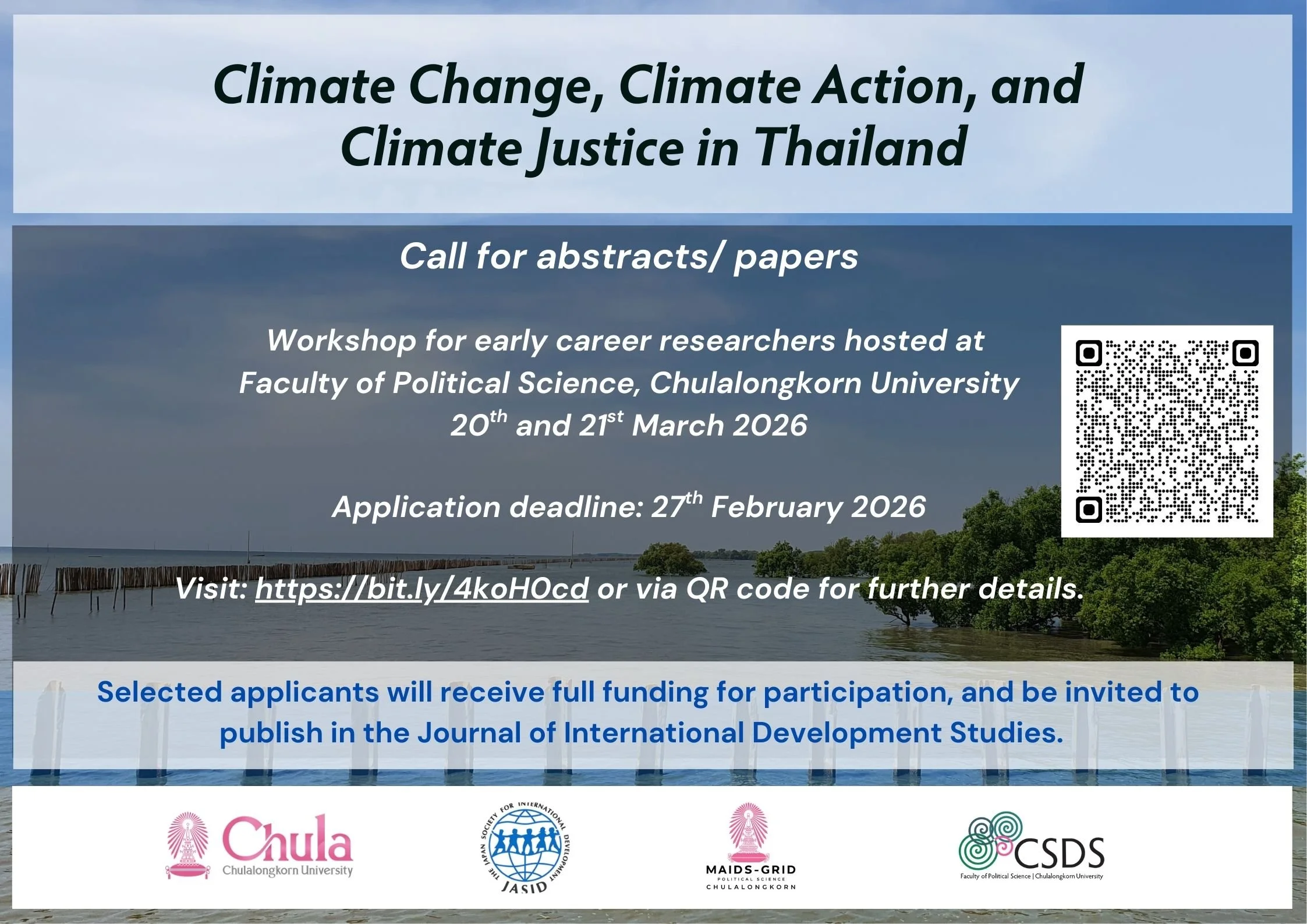
Call for abstracts
Climate Change, Climate Action, and Climate Justice in Thailand
20th and 21st March 2026
Faculty of Political Science, Chulalongkorn University, Bangkok, Thailand
Co-organized by Center for Social Development Studies (CSDS) and M.A. and Ph.D. Program in International Development Studies (MAIDS-GRID), Faculty of Political Science, Chulalongkorn University; and Japan Society for International Development
Introduction
The impacts of climate change are a growing challenge across Thailand, with consequences for people and non-humans in rural and urban areas. Long-term trends such as shifting weather patterns and warming temperatures, alongside climate-related disasters, such as floods and droughts, intersect with social inequality resulting in unequal distribution of risks and harms. Acknowledging the magnitude of the challenge, in December 2025, Thailand’s Climate Change Act (TCCA) was approved by the government, introducing various measures include new national governance bodies, plans for a climate fund, carbon taxes, and emissions trading, and new strategies for adaptation planning. Whether the TCCA can respond to the escalating challenge of climate change remains to be seen. These domestic responses are in the context of global governance arrangements and its geopolitics, including commitments within the increasingly challenged UNFCCC, as well as the implications of the EU’s Carbon Adjustment Border Mechanism for Thailand’s export driven economy
Yet, considering the politics of ‘green transformation’ in Thailand, climate change raises questions about diverse ways of actions, adaptations, and justices in an increasingly insecure and uncertain future. At first glance, the range of these questions extends from the resilience to energy, food and water (in)security, to new trends in climate (im)mobilities, to the role of state and non-state actors in the adaptation processes. Conversely, the perspective of pluriversal politics raises more fundamental queries on what climate change is because it is “ontologically unframeable, unthinkable and incalculable” (Akomolafe 2019 cited in Escobar 2025). What’s more, long-standing contestations on defining and securing climate justice from the global to the local level remain unresolved and intractable.
Call for abstracts / papers
Bearing the above problematique in mind, this WriteShop invites abstracts/ full papers from early career researchers in Southeast Asia whose work addresses any of the following themes, or related questions under the overarching theme “Climate Changes, Climate Actions and Climate Justices in Thailand”:
Impacts, responses and climate justice implications of worsening climate-related disasters, such as floods, droughts and changing seasonal weather patterns
Urban and rural community experiences of climate change, and community-led climate adaptation
The intersection of climate change with social inequality in Thailand
The opportunities and challenges of Thailand’s Climate Change Act and other public policies
Positioning Thailand within international responses to climate change, including UNFCCC and the EU Carbon Adjustment Border Mechanism
The implications of international climate finance, including carbon credits, access to loss and damage funds, and climate adaptation funds
The politics of ‘green transformation’ responding to climate change, including in energy, food, and transport systems
Patterns and politics of climate (im)mobilities within Thailand and across borders ·
The role of civil society and social movements in climate actions and climate justices
Ontological politics of climate change
The selected papers will be invited to a WriteShop at Chulalongkorn University, and will receive feedback and support to finalize their papers in English for submission to the Journal of International Development Studiesiv. The journal is a double-blind peer reviewed journal published by JASID. Domestic and regional travel grants are available to Bangkok for selected participants.
Abstract submission and timeline
| Date | |
|---|---|
| 27 February 2026 | Submission of abstract (max 250 words) and a brief bio including your name, affiliation, and current country/ location of residence. |
| 4 March 2026 | Selected abstracts announced |
| 16 March 2026 | Submission of draft papers (4500 words) |
| 20-21 March 2026 | WriteShop at Chulalongkorn University, Bangkok |
| 1 May 2026 | Submission of revised full papers for peer review |
For inquiries and submission of abstracts, please contact: Dr. Carl Middleton (Carl.M@Chula.ac.th). With your abstract submission, please include a brief bio including your name, affiliation, and current country/ location of residence.