UPCOMING WORKSHOP: Call for abstracts/ papers - Climate Change, Climate Action, and Climate Justice in Thailand

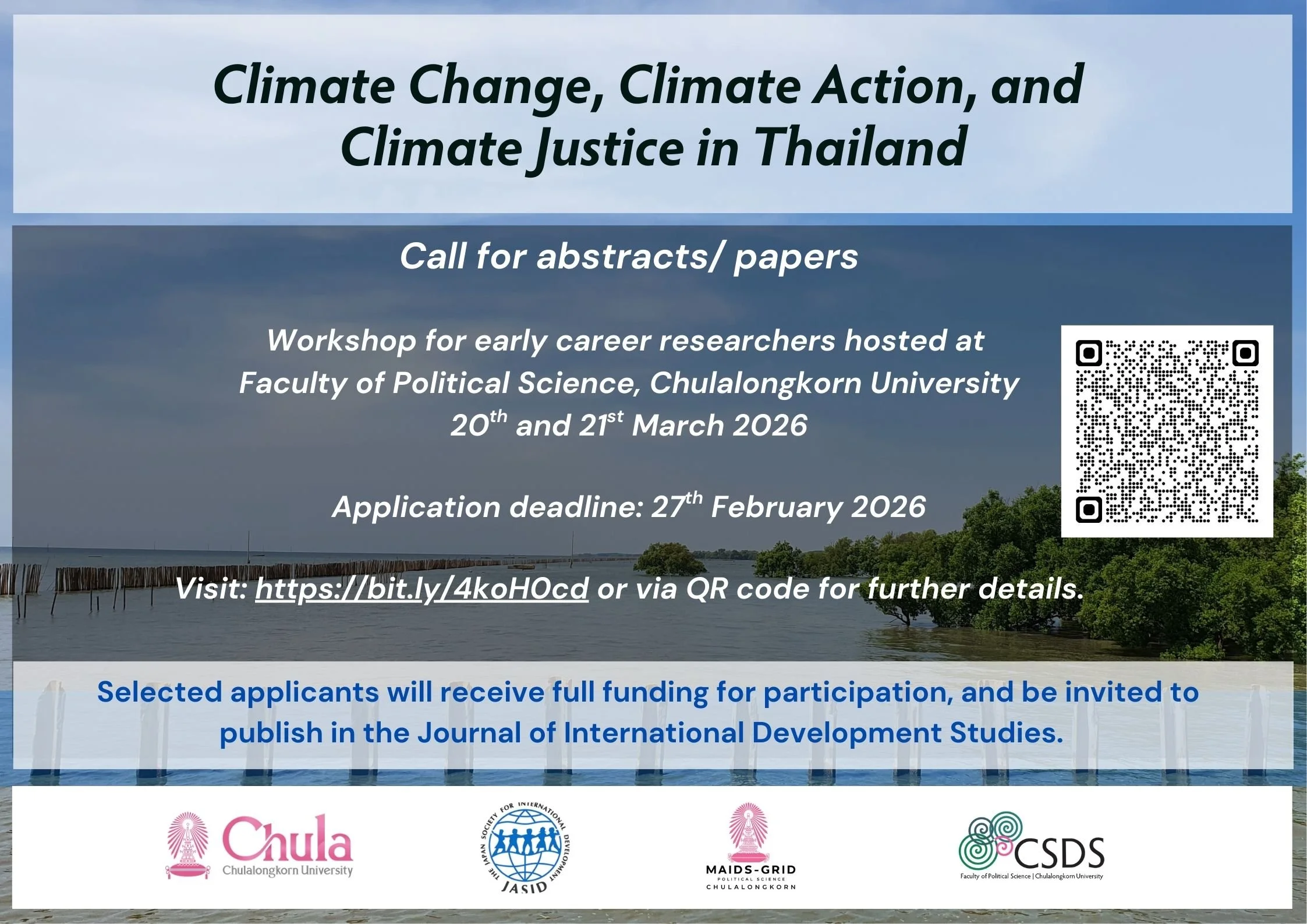
Call for abstracts

Climate Change, Climate Action, and Climate Justice in Thailand

20th and 21st March 2026

Faculty of Political Science, Chulalongkorn University, Bangkok, Thailand

Co-organized by Center for Social Development Studies (CSDS) and M.A. and Ph.D. Program in International Development Studies (MAIDS-GRID), Faculty of Political Science, Chulalongkorn University; and Japan Society for International Development

Introduction

The impacts of climate change are a growing challenge across Thailand, with consequences for people and non-humans in rural and urban areas. Long-term trends such as shifting weather patterns and warming temperatures, alongside climate-related disasters, such as floods and droughts, intersect with social inequality resulting in unequal distribution of risks and harms. Acknowledging the magnitude of the challenge, in December 2025, Thailand’s Climate Change Act (TCCA) was approved by the government, introducing various measures include new national governance bodies, plans for a climate fund, carbon taxes, and emissions trading, and new strategies for adaptation planning. Whether the TCCA can respond to the escalating challenge of climate change remains to be seen. These domestic responses are in the context of global governance arrangements and its geopolitics, including commitments within the increasingly challenged UNFCCC, as well as the implications of the EU’s Carbon Adjustment Border Mechanism for Thailand’s export driven economy

Yet, considering the politics of ‘green transformation’ in Thailand, climate change raises questions about diverse ways of actions, adaptations, and justices in an increasingly insecure and uncertain future. At first glance, the range of these questions extends from the resilience to energy, food and water (in)security, to new trends in climate (im)mobilities, to the role of state and non-state actors in the adaptation processes. Conversely, the perspective of pluriversal politics raises more fundamental queries on what climate change is because it is “ontologically unframeable, unthinkable and incalculable” (Akomolafe 2019 cited in Escobar 2025).  What’s more, long-standing contestations on defining and securing climate justice from the global to the local level remain unresolved and intractable.

Call for abstracts / papers

Bearing the above problematique in mind, this WriteShop invites abstracts/ full papers from early career researchers in Southeast Asia whose work addresses any of the following themes, or related questions under the overarching theme “Climate Changes, Climate Actions and Climate Justices in Thailand”:

  • Impacts, responses and climate justice implications of worsening climate-related disasters, such as floods, droughts and changing seasonal weather patterns 

  • Urban and rural community experiences of climate change, and community-led climate adaptation 

  • The intersection of climate change with social inequality in Thailand 

  • The opportunities and challenges of Thailand’s Climate Change Act and other public policies 

  • Positioning Thailand within international responses to climate change, including UNFCCC and the EU Carbon Adjustment Border Mechanism 

  • The implications of international climate finance, including carbon credits, access to loss and damage funds, and climate adaptation funds 

  • The politics of ‘green transformation’ responding to climate change, including in energy, food, and transport systems 

  • Patterns and politics of climate (im)mobilities within Thailand and across borders ·       

  • The role of civil society and social movements in climate actions and climate justices 

  • Ontological politics of climate change 

The selected papers will be invited to a WriteShop at Chulalongkorn University, and will receive feedback and support to finalize their papers in English for submission to the Journal of International Development Studiesiv. The journal is a double-blind peer reviewed journal published by JASID. Domestic and regional travel grants are available to Bangkok for selected participants.  

Abstract submission and timeline


Date                         
27 February 2026               Submission of abstract (max 250 words) and a brief bio including your name, affiliation, and current country/ location of residence. 
4 March 2026  Selected abstracts announced 
16 March 2026 Submission of draft papers (4500 words) 
20-21 March 2026 WriteShop at Chulalongkorn University, Bangkok 
1 May 2026  Submission of revised full papers for peer review 

For inquiries and submission of abstracts, please contact: Dr. Carl Middleton (Carl.M@Chula.ac.th). With your abstract submission, please include a brief bio including your name, affiliation, and current country/ location of residence.

UPCOMING EVENT: The Future of Sustainability: The Bio-Cultural Diversity Imperative [22 March 2024]

Indigenous-led Research Advancing Solutions to Climate Change

22-23 March 2024

We are living in a time that many academics and scientists refer to as the Anthropocene. As a controversial buzzword, the term Anthropocene implies unfolding anthropogenic impacts on the planet at an unprecedented rate and scale causing the accelerated global warming, unstable climate, changes to ecosystems and biodiversity, and extinction of species. Across the world, extreme weather event is becoming the new normal. Fuelled by human activity and carbon pollution, climate change is contributing to extreme weather events.

Indigenous communities across the world are disproportionally affected by the direct consequences of climate change. They inhabit ecologically sensitive areas that are becoming increasingly vulnerable to climate impacts. Their vulnerability is compounded by their dependence upon, and close relationship with the environment and its resources. Climate change exacerbates the difficulties and challenges already faced by indigenous communities, including political and economic marginalisation, loss of land and resources, human rights violations, discrimination and unemployment.

In the past, indigenous communities were often viewed as victims of the effects of climate change. However, indigenous communities are inextricably linked with their lands and possess a unique collective knowledge of their environments. With their traditional knowledge, indigenous communities have a key role to play in combating climate change, cutting across both climate mitigation and adaptation efforts. Therefore, indigenous peoples must be viewed as powerful change agents in contributing to effective climate action and sustainable development.

Indigenous communities represent a wealth of traditional practices, adaptive strategies, and a profound understanding of their ecosystems. Thus, placing indigenous knowledge at the centre of climate policy making is a strategic imperative. On one hand, it is a matter of urgency to increase the understanding and addressing the unique climate challenges faced by indigenous communities. On the other hand, enhancing the role played by indigenous groups in driving climate policy and action is equally critical. Indigenous led research and knowledge co-production provide opportunities for social learning and intersectional approaches to improve policies and plans.

To tackle complex development and climate challenges, there is a pressing need to improve understanding and share knowledge on science policies and best practices to address social inequality, poverty, and vulnerabilities, assess and identify technology needs and facilitating technology transfer for adaptation and mitigation, and integrate climate change into national and sectoral policies and development plans.

New forms of knowledge production are necessary to respond to the complexity of social, environmental, and economic concerns for sustainable development. Knowledges that are context-driven and problem-focused require the engagement of diverse social groups and multiple disciplines. Ecological, social and economic challenges have led to a growing recognition that transformative approaches are required that will require new ways of knowing, valuing and acting in the world.  In this context, the knowledge, values and actions of indigenous peoples and others who aspire through local practices for sustainability and social and ecological justice have a key role to play in this transformation.

Crucial to transformation is a clear vision for the future to be attained, yet grassroots-up deliberations on the future is less common. While the future is yet to exist, visions and expectations towards the future are conditioned by the past and impact on the possibilities of the present. The ‘Summit of the Future’ will take place at the United Nations in New York City on September 22-23, 2024.  It aspires to deliver a ‘Pact for the Future’ outcome document, intended to guide “a world – and an international system – that is better prepared to manage the challenges we face now and in the future, for the sake of all humanity and for future generations.”

International workshop on Indigenous led research advancing solutions to climate change

The 22-23 March 2024 event, co-hosted by the University of Michigan and Chulalongkorn University, will bring together multi-disciplinary scholars and special guests from Bangladesh, China, Nepal, the Philippines, USA and Thailand to share and discuss bio-cultural diversity, ecological crisis, environmental justice, and sustainability futures. With an aim to strengthen the science-policy interface in driving the role of indigenous communities in climate change, the event will enhance academic networks and serve as a co-learning platform for indigenous led research.

On the 22nd of March 2024, discussion panels on ‘No Sustainable Development without Environmental Justice: The Indigenous People and Local Communities Platform’ and ‘Indigenous-led Research and Policy Engagement for Human and Planetary Futures’ will be held at the Social Innovation Hub from 8.30am to 12pm.

On the 23rd of March 2024, a workshop will undertake a ‘Futures Lab’ process to collectively explore alternative futures, and to connect the local to the global and the international systems that structure it. Participants include experienced and academics and civic society leaders working at the global, regional and local level, as well as graduate students. The workshop will suggest actions that may inform an agenda towards the ‘Summit of the Future.’

Here is the agenda;