
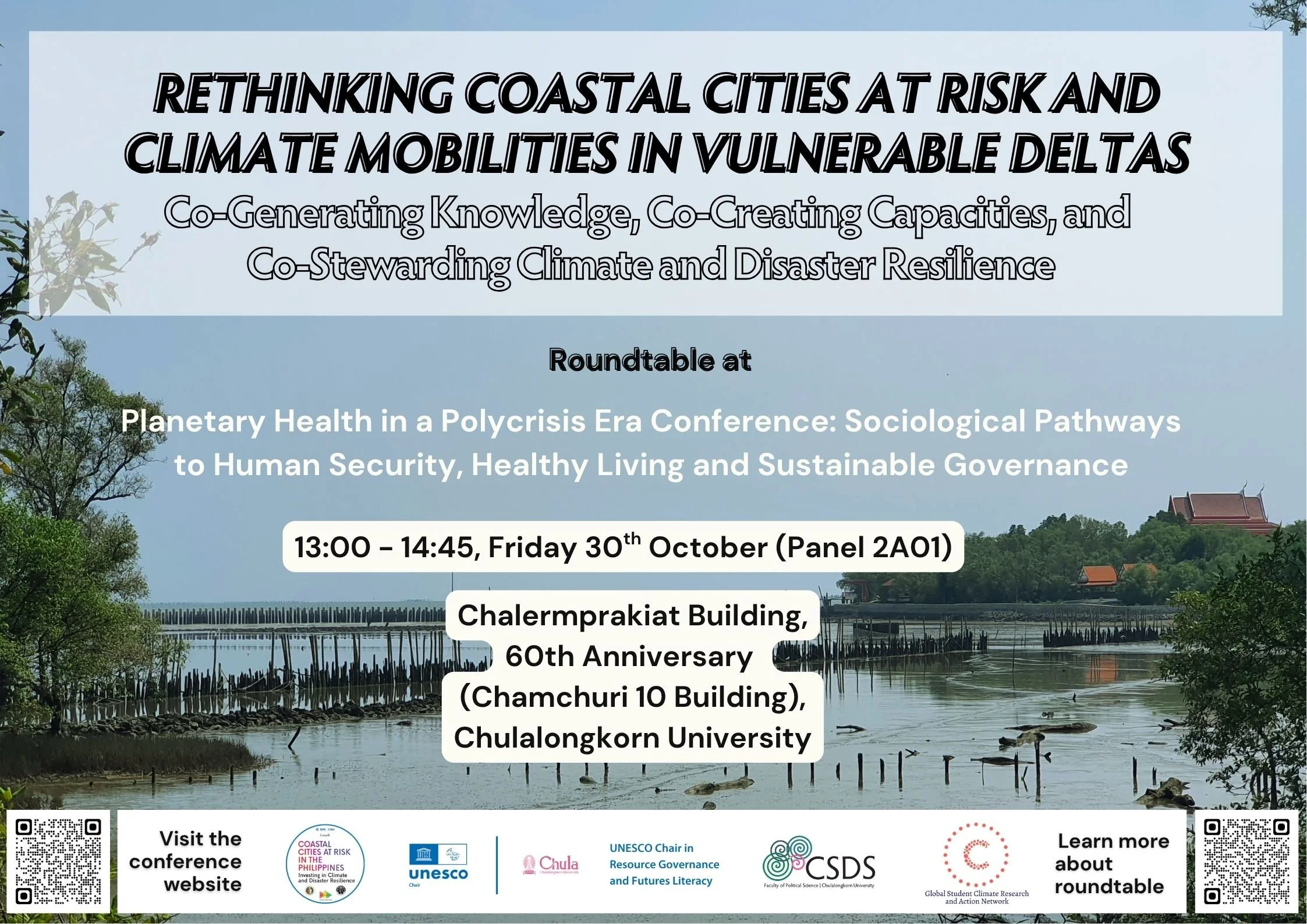
UPCOMING ROUNDTABLE: RETHINKING COASTAL CITIES AT RISK AND CLIMATE MOBILITIES IN VULNERABLE DELTAS
/
Download the full roundtable details here.
Visit the conference website for registration here.
Session description
Delta regions across Southeast Asia historically until present are important locations of urban, rural and coastal communities. Accelerated industrial development in the 20th century transformed many major delta regions, with growing populations, increasing resource extraction and use, and associated environmental pressures. Communities in urban and rural spaces face multiple – and uneven – vulnerabilities rooted in historical and present-day development plans, policies and practices. These include land subsidence due to groundwater over-extraction; land and environment degradation following industrial and agroindustry expansion; destructive flooding and drought shaped by wider watershed changes including deforestation, large hydropower and irrigation dam construction, and sand mining; and coastal erosion accelerated by loss of mangroves and disrupted sediment flows impacting delta rebuilding processes. Climate change – both rapid and slow onset – interacts with these pre-existing vulnerabilities by changing seasonal weather patterns, exacerbating extreme weather disasters, and causing sea levels rise.
Coastal cities, for example, confront intersecting climate risks, rapid urbanization, social inequality, informality, and uneven institutional capacities. Yet building resilience requires more than producing better climate science or strengthening infrastructure. It requires reinventing how scientists, governments, communities, civil society, and the private sector work together.
Drawing from the transdisciplinary experience of Coastal Cities at Risk in the Philippines (CCARPH) and its collaborative partnerships with the Manila Observatory, National Resilience Council, local governments, civil society organizations, community-based organizations, and other partners, this session first examines collaborative pathways for risk-informed, socially inclusive, and resilience-driven urban governance. The session will introduce a Co-Reinvention Cycle grounded in six interrelated processes: co-defining risks and priorities; co-generating knowledge; co-creating capacities and solutions; co-owning and co-stewarding implementation; realizing co-benefits for people, communities, and cities; and co-learning for continuing transformation.
In the second part of the session, a round table will explore the political economy, policy and politics of climate mobility in delta regions and coastal cities of Southeast Asia. Southeast Asia has long been characterized by peoples’ mobility. Migration from rural to urban areas domestically and transnationally has been a characteristic of policies promoting industrialization for economic growth. Mobility has also included various forced displacements including due to conflict, and land and resource dispossession. Climate change is also increasingly shaping mobilities, where decisions to migrate are shaped by a complex interaction of cultural, demographic, economic, political, and social processes. In Southeast Asia, the impacts of resource extraction linked to ‘green transition’ policies on, for example, critical minerals mining and ‘renewable’ energy development are also reinforcing unequal domestic and transnational (im)mobilities, with potential implications for delta cities. The roundtable will critically examine current trends in national, regional and global policy and research agendas, and identify gaps and future priorities. It will also reflect on the collaborative pathways for risk-informed, socially inclusive, and resilience-driven urban governance, and the Co-Reinvention Cycle.
Overall, rather than positioning communities as recipients of scientific knowledge, the session asks how scientific expertise, policy authority, professional practice, local knowledge, lived experience, and community capacities can be brought into sustained relationships of shared responsibility. Cases involving local governments and marginalized communities will illustrate how collaborative partnerships can connect climate and disaster risk assessment with local planning, capacity development, social protection, resilience investments, and community innovations
Key questions
How can coastal deltas and cities within them reinvent collaborative governance so that climate and disaster resilience is co-generated, co-created, co-owned, and co-stewarded by scientists, governments, communities, civil society, and the private sector?
How does climate and environmental change, agrarian change, conflict, land-use change and infrastructure decisions intersect in various circumstance to produce vulnerabilities, and shape climate (im)mobilities differently for different groups of people?
Speakers
Session keynote: Reinventing Coastal Cities at Risk
Emma Porio, PhD - CCARPH Project Leader and Principal Investigator; Professor Emeritus, Ateneo de Manila University; Science Research Fellow, Manila Observatory.
Joshua Vidal - Transdisciplinary Research Associate, CCARPH-Ateneo de Manila University.
Roundtable Discussion: Climate Change, Mobility and Development in Southeast Asia’s Deltas and Cities
Nguyen Thi Hai Ninh, PhD. - Associate Professor, Faculty of Economic and Management, Vietnam National University of Agriculture
Haryani Saptaningtyas, PhD. - Lecturer, Postgraduate School, Sebelas Maret University
Sri Suryani, PhD. - Lecturer, Housing and Settlement Research Group, Institut Teknologi Bandung
Eaindra Theint Theint Thu, PhD - Postdoctoral fellow, Center for Social Development Studies, Faculty of Political Science, Chulalongkorn University
Clare Steiner - Research Associate, Stockholm Environment Institute-Asia
Nguyen Thi Hoang Nguyen - Researcher, Humanitarian Observatory for Policy and Education in Southeast Asia), School of Public Policy, Chiang Mai University
Roundtable facilitator: Carl Middleton, PhD. - Associate Professor, Faculty of Political Science, Chulalongkorn University
Download the full roundtable details here
Visit the conference website for registration here.