
CSDS Newsletter: October - December 2020
/View the full newsletter on this link.

View the full newsletter on this link.
2020 has been a tough year for everyone, but thanks to your continuous support, we're able to spend it meaningfully. We’ve organized 4 (four) public events, participated in 11 (eleven) invitations, and publish 12 (twelve) publications, and there’s also significant increase in visitors to our website as well as page views, and also an increase in our social media presence.
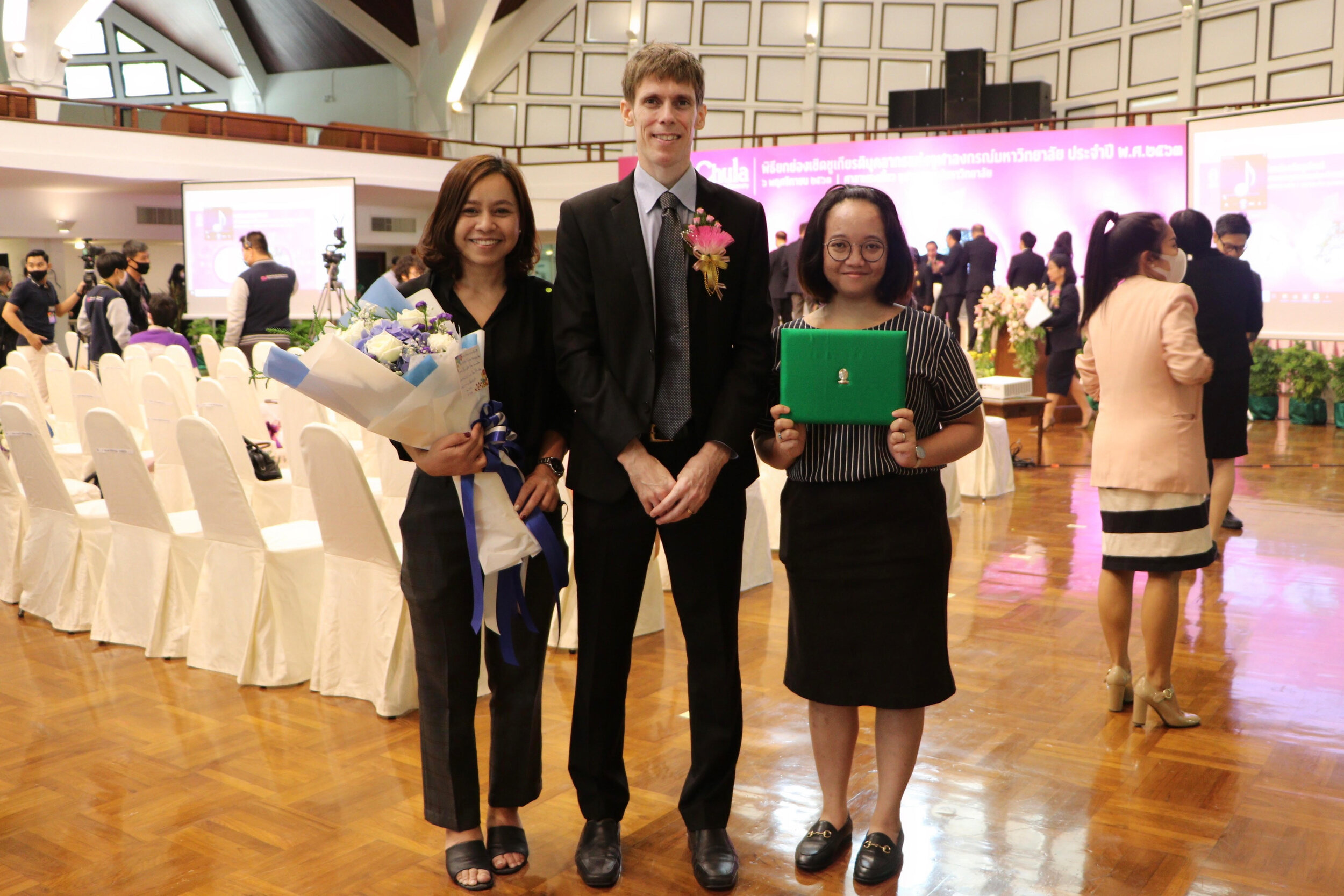
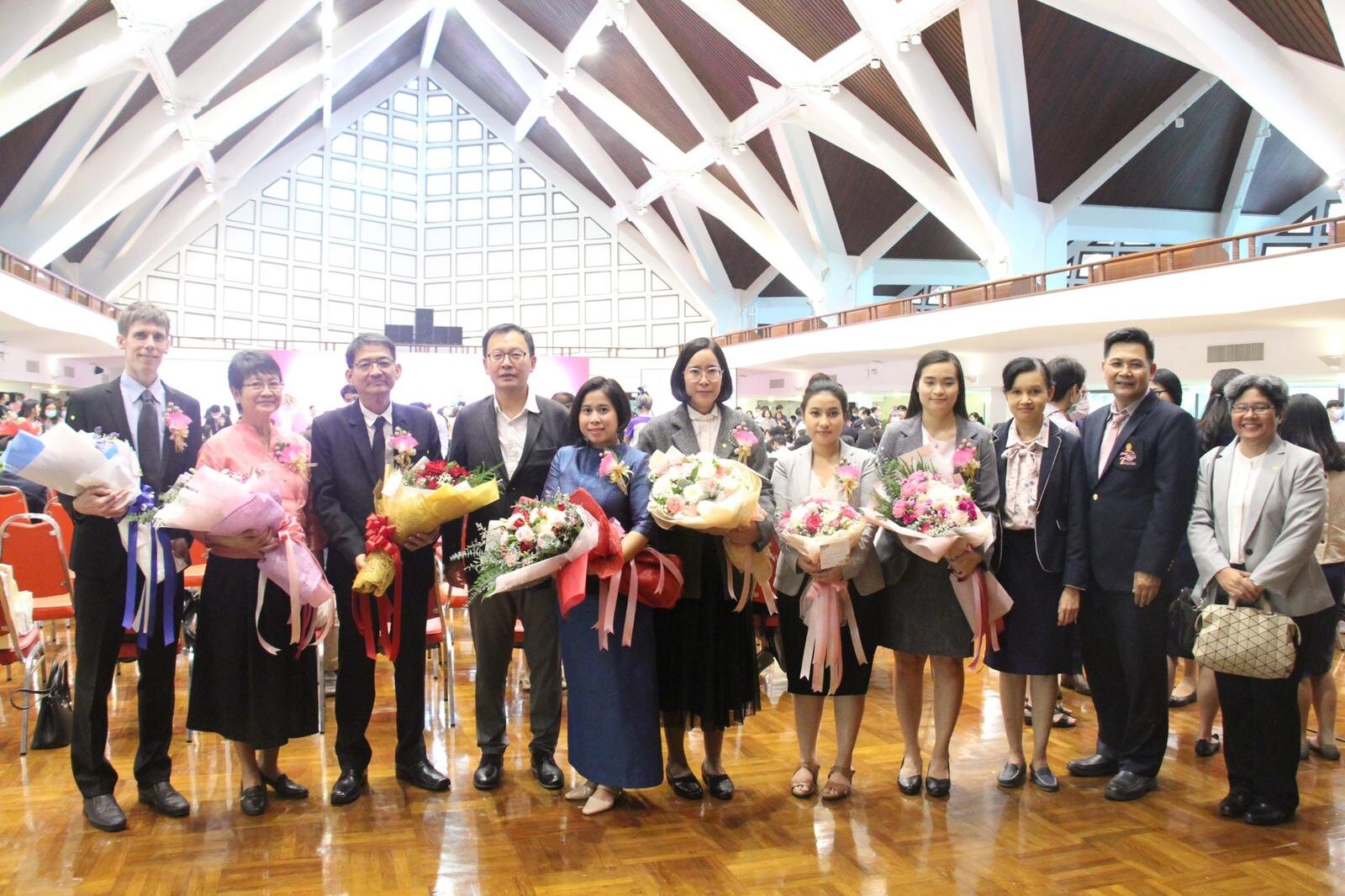
This year, we also received the “Center of Excellence (CE) with Outstanding Performance” award from Chulalongkorn University. This annual award is presented to recognize the research achievements of the researchers within the center and their research over the previous year. Our team are honored to receive this award and its recognition of our ongoing work.
Thank you for your support this year, and please look forward to our projects in next year too!
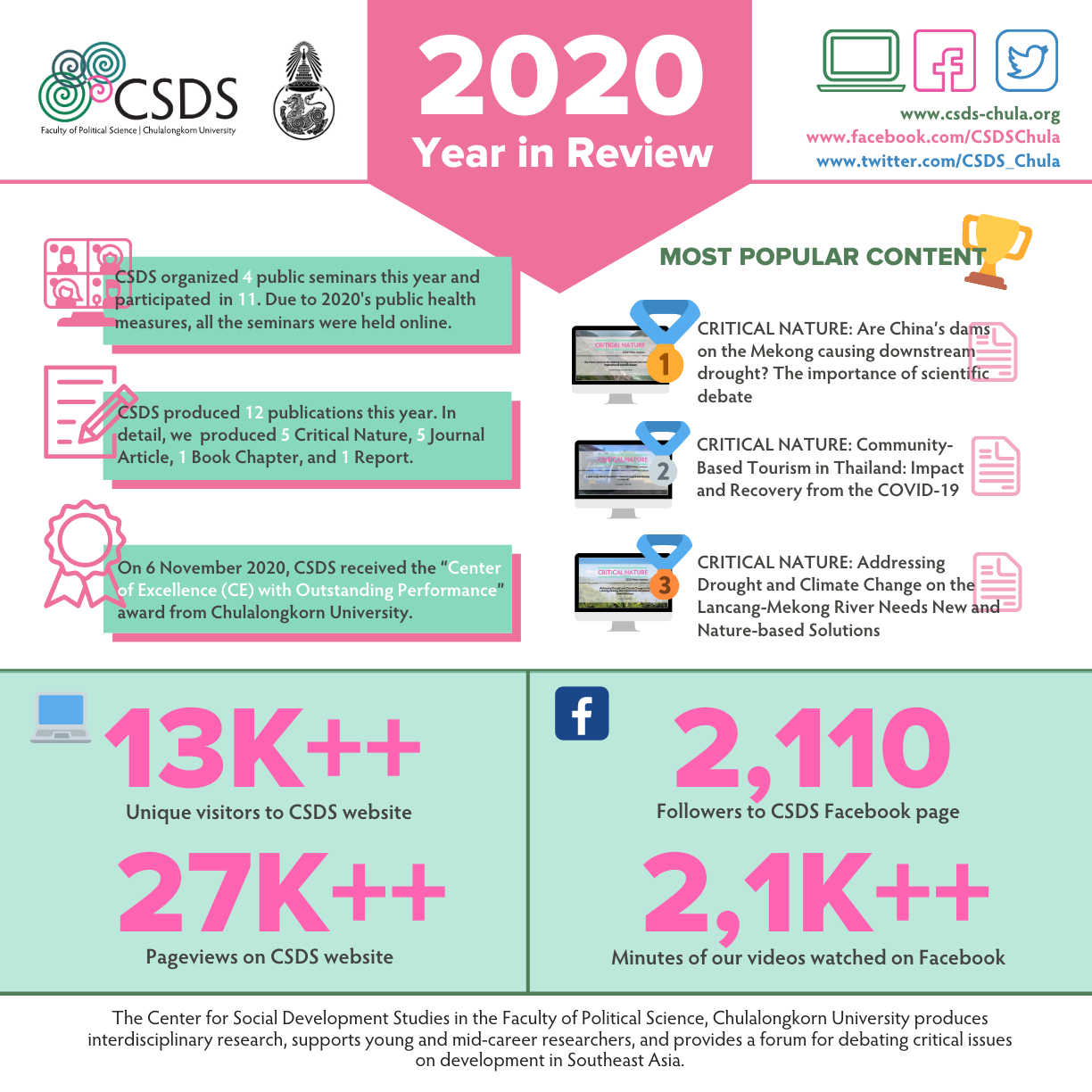
Due to 2020's public health measures, all the public events were held online.
Building Power from Within: Rural and Indigenous Community Organizing
Haze and Social (In)Justice in Southeast Asia: Past Experience and What Next?
New Research on COVID 19 and its Consequences: People, Planet and Inclusive Society
Book Chapter
Critical Nature
Addressing Drought and Climate Change on the Lancang-Mekong River Needs New and Nature-based Solutions - Thai version available here.
Are China’s dams on the Mekong causing downstream drought? The importance of scientific debate
Community-Based Tourism in Thailand: Impact and Recovery from the COVID-19 - Thai version available here.
Beyond Water Data Sharing, Mekong-Lancang River Needs Accountable Water Governance
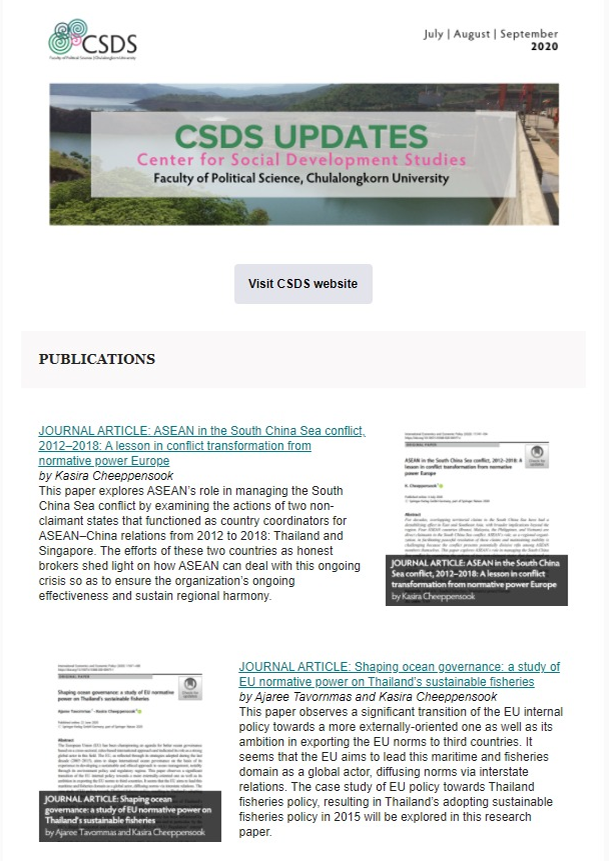
Journal Article
Report

Mark your calendars, from 8 to 12 December 2020, the High-Level Futures Literacy Summit will provide testimonials from around the world that being futures literate changes what people see and do. From high ranking leaders in the public and private sector to activists, artists, students and professors, the Summit will show how people become futures literate and the impact it has on all aspects of life, from dealing with COVID-19 to breaking the reproduction of oppression.
Now, as always, the future is uncertain. Climate change, pandemics, economic crisis, social exclusion, racism, oppression of women, inter-generational conflict, and more, shatter the conventional images of the future that humans use to feel secure, to be confident enough to invest in tomorrow.
This is not a small problem. Without images of the future that inspire hope and foster collaboration there is a high risk of despair and war. The malaise of poverty-of-the-imagination must be overcome.
Register Now!
Chula at UNESCO High-Level Futures Literacy Summit
Futures Literacy, a universally accessible skill that builds on the innate human capacity to imagine the future, offers a clear, field tested solution to poverty-of-the imagination.
This hybrid event will provide testimonials from around the world how being Futures Literate changes what people see and do and innovate the present. The event consists of Summit Plenary engaging in “future conversation” by world leaders, Agora (virtual exhibition) from more than 50 leading institutions and Global Futures Literacy Network side-events online. Chulalongkorn University, the only invited participating institution at the Summit from Thailand, will join the Summit Plenary and showcase its flagship projects in Agora, aiming to reach out future collaborators and partnerships across the world.
Dates: December 8-12, 2020
Register: click here
For further information: The Event, More on Futures Literacy

15.40-17.30, Friday, 4 December 2020 via Zoom
Carl Middleton from CSDS will be presenting on this event.
The Asia Research Institute, National University of Singapore, is going to organize an inter-disciplinary workshop on "Transboundary Environmental Governance in Southeast Asia" to explore how, why, when and what forms of transboundary environmental governance are emerging in Southeast Asia.
The workshop will be conducted online via Zoom. To register, please visit this link here and the organizer will reply prior to the event with the Zoom link.
Panel IV. Hybrid Governance of Transboundary Commons
Chairperson: Zu Dienle Tan, National University of Singapore
Panelists:
Beyond the Commons/Commodity Dichotomy in the Lancang-Mekong Basin: Implications for Transboundary Water Governance by Carl Middleton, Chulalongkorn University
Unruly Fires: Nonhumans as Transboundary Actants in Governing Indonesia’s Wildfires by Rini Astuti, National University of Singapore and Yuti Ariani Fatimah, Nanyang Technological University
A Multi-Scalar Political Economy Analysis of Thailand’s Widespread Urban Air Pollution by Danny Marks, Dublin City University
Path Dependency of Land Use in Southeast Asian Peatlands by Lahiru Wijedasa, National University of Singapore
Abstract:
Beyond the Commons/Commodity Dichotomy in the Lancang-Mekong Basin: Implications for Transboundary Water Governance
Extensive hydropower construction across the Lancang-Mekong basin is changing the river’s hydrology and ecology, with implications for the availability and governance of common pool resources, as well as for riparian livelihoods. In this paper, I assess how the transboundary commons are being reworked as the river is transformed by large dam operation. The paper applies an analytical lens that seeks to move beyond a commons-commodity dichotomy in water related resource governance (Paerregaard and Andersen, 2019) to argue that at the present time the Lancang-Mekong River is neither fully commodified nor fully a commons, but rather a hybrid of the two. The paper will examine how transboundary hybrid governance regimes are reworking the hybrid commons, drawing attention to how states, communities, and even private actors, seek to maintain particular types of commons, whilst simultaneously either furthering or resisting commodification of some properties of the river. The paper will discuss the implications of this hybrid governance perspective for recent hydropolitics in the river basin and existing and new transboundary water governance institutions, namely the Mekong River Commission and the Lancang-Mekong Cooperation framework.
For more information about this event, please visit the organizer’s webpage here.

15.00-16.30 (Thailand time), Tuesday, 24th November 2020
Carl Middleton from CSDS will moderate this panel.
This panel discussion will address the challenges of the renewable energy transition in the Asia and the Pacific region, hosted as part of the REN21 Virtual Academy 2020. The panel will address the following four topics: 1) Tackling Asia’s coal investments to meet nationally determined contributions (NDCs) as committed in the Paris Agreement on Climate Change, and mitigate air pollution; 2) Providing low-cost and effective sustainable energy options to eliminate energy poverty; 3) Accelerating regional connectivity for sustainable energy; and 4) Applying energy-water-food nexus lens in sustainable energy planning and investments.
The panelists are:
Ms. Monica Yamin Wang, Director, REpowering Asia, WWF
Mr. Abhishek Jain, Director, Powering Livelihoods, Council on Energy, Environment and Water
Dr. Akbar Swandaru, Lead Researcher, ASEAN Center for Energy
Ms. Bridget McIntosh, Country Director for Cambodia, Energy Lab
Following brief framing presentations by each speaker, all session participants are invited into an interactive online space to discuss the four topics outlined and to interact with the speakers.
To learn more about and register for the REN21 Virtual Academy 2020, please visit here: https://www.ren21.net/2020-ren21-academy/
Read more about CSDS's research on the water-food-energy nexus here.
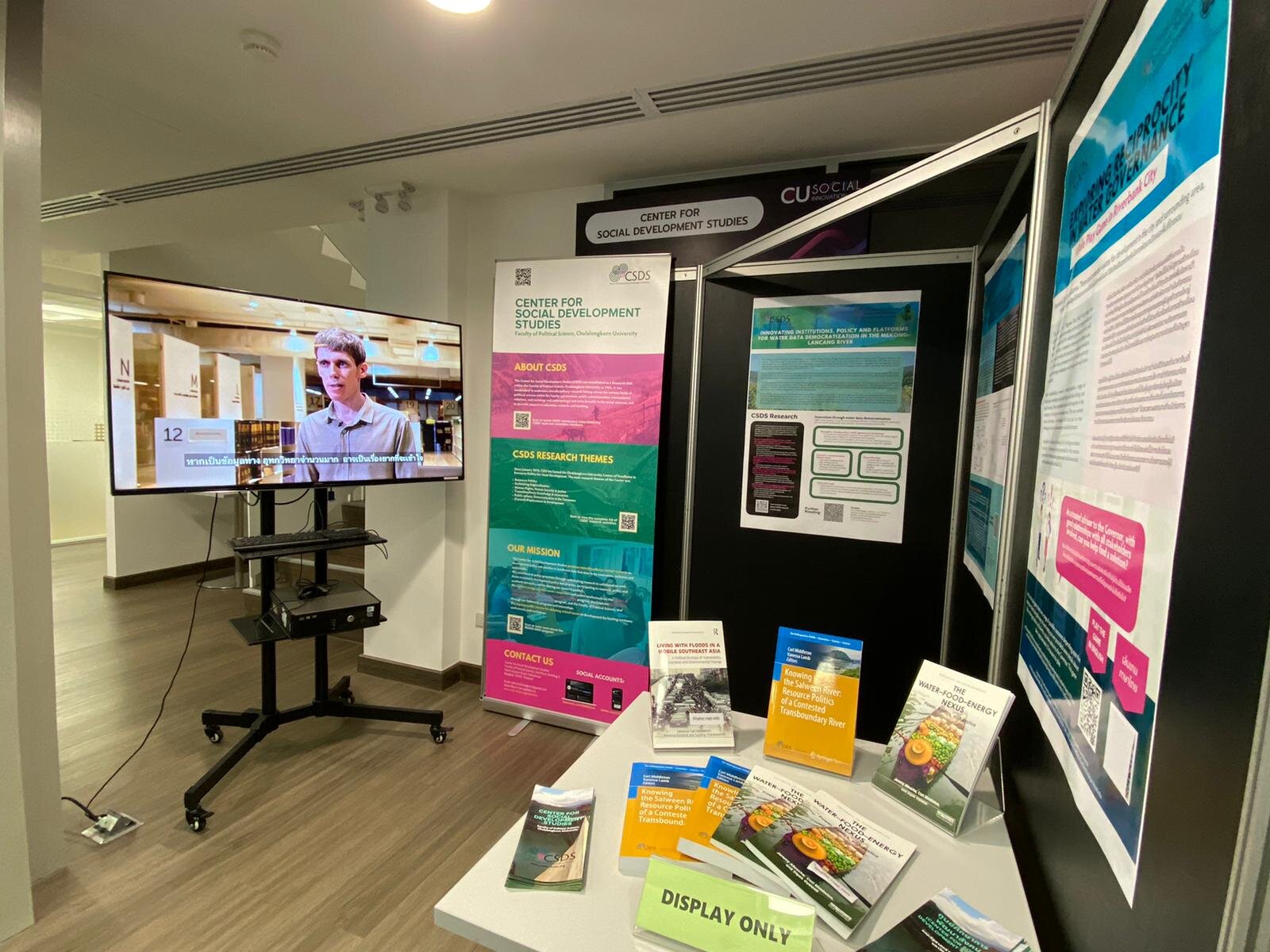
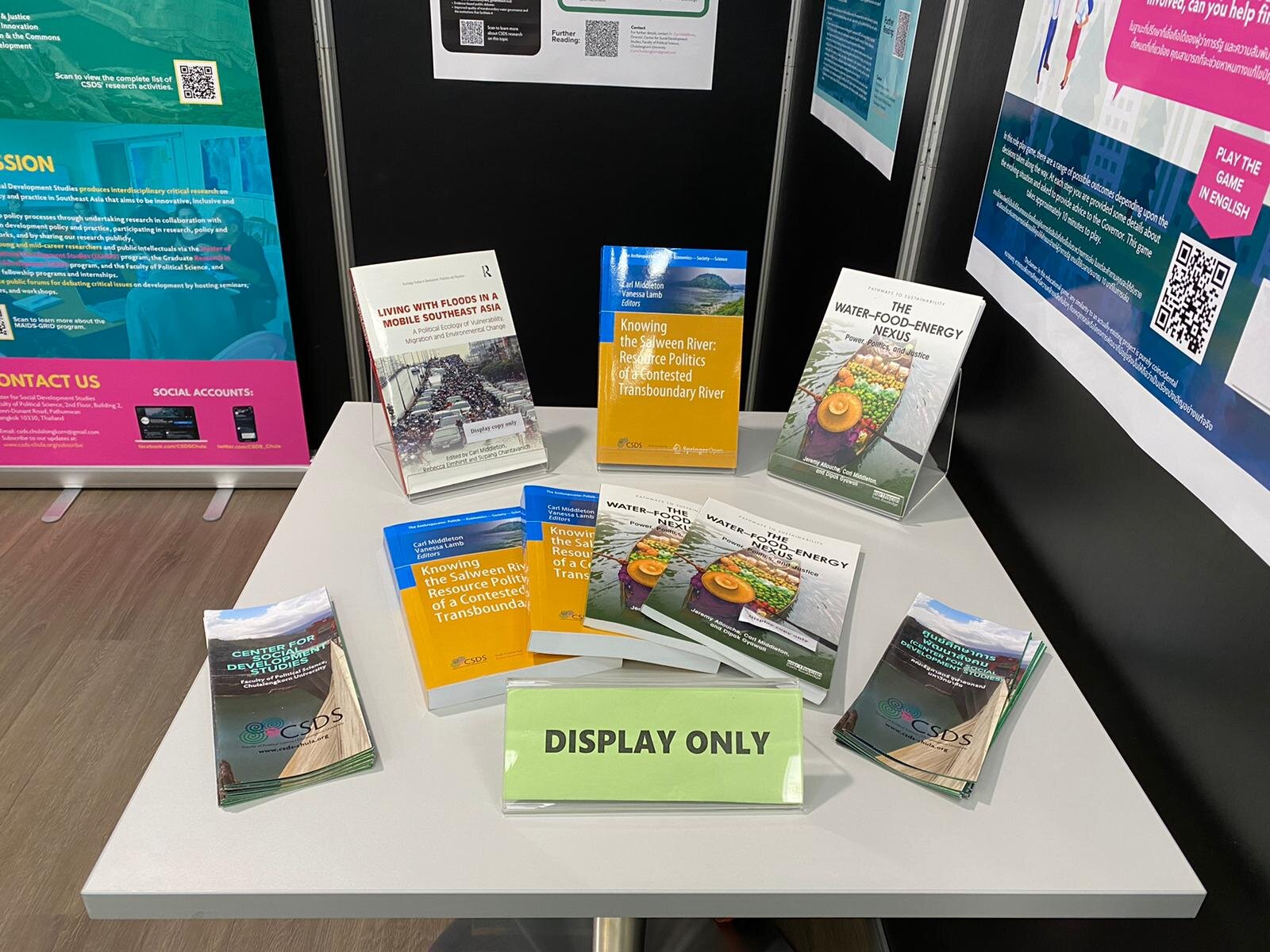
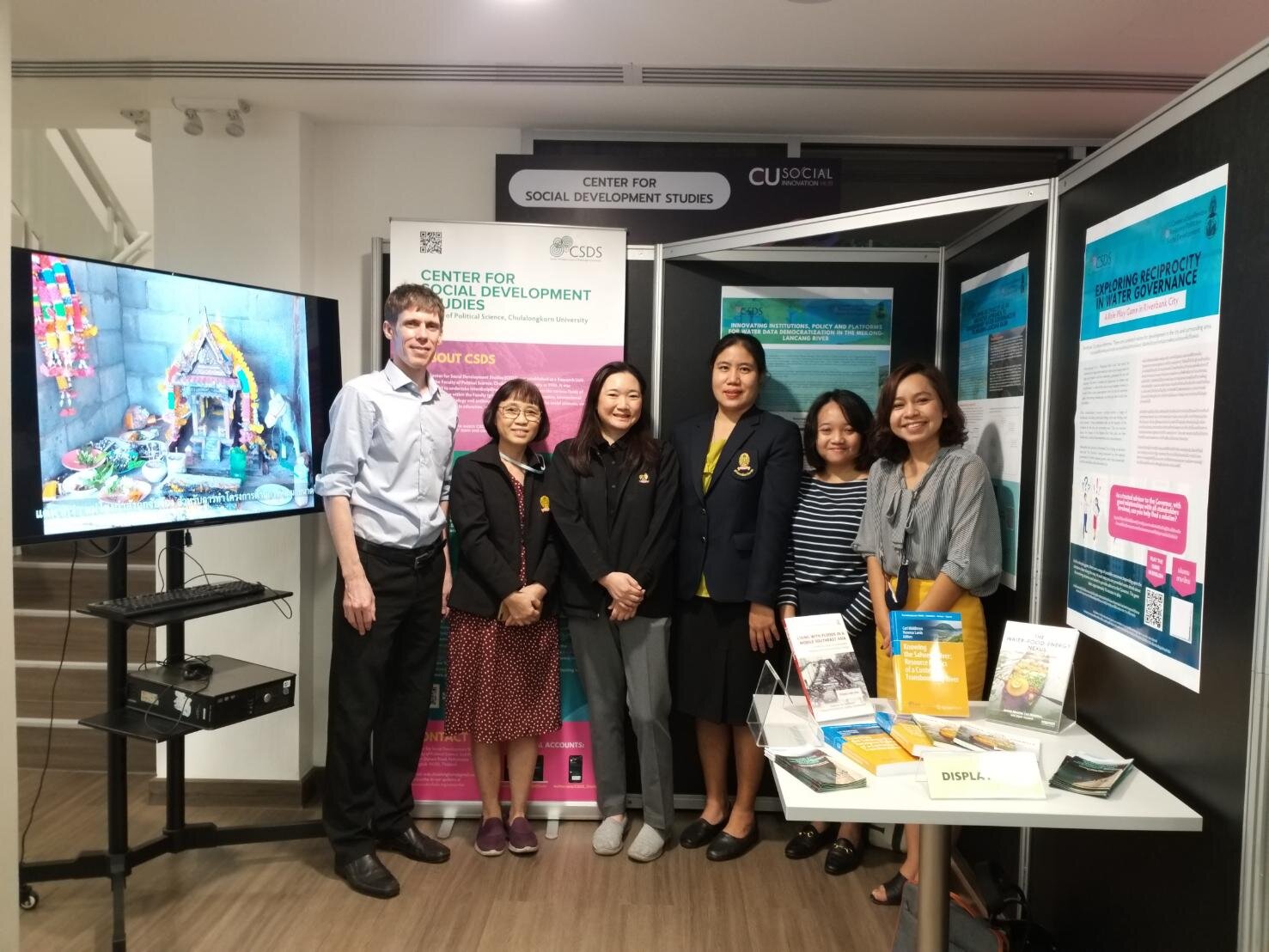
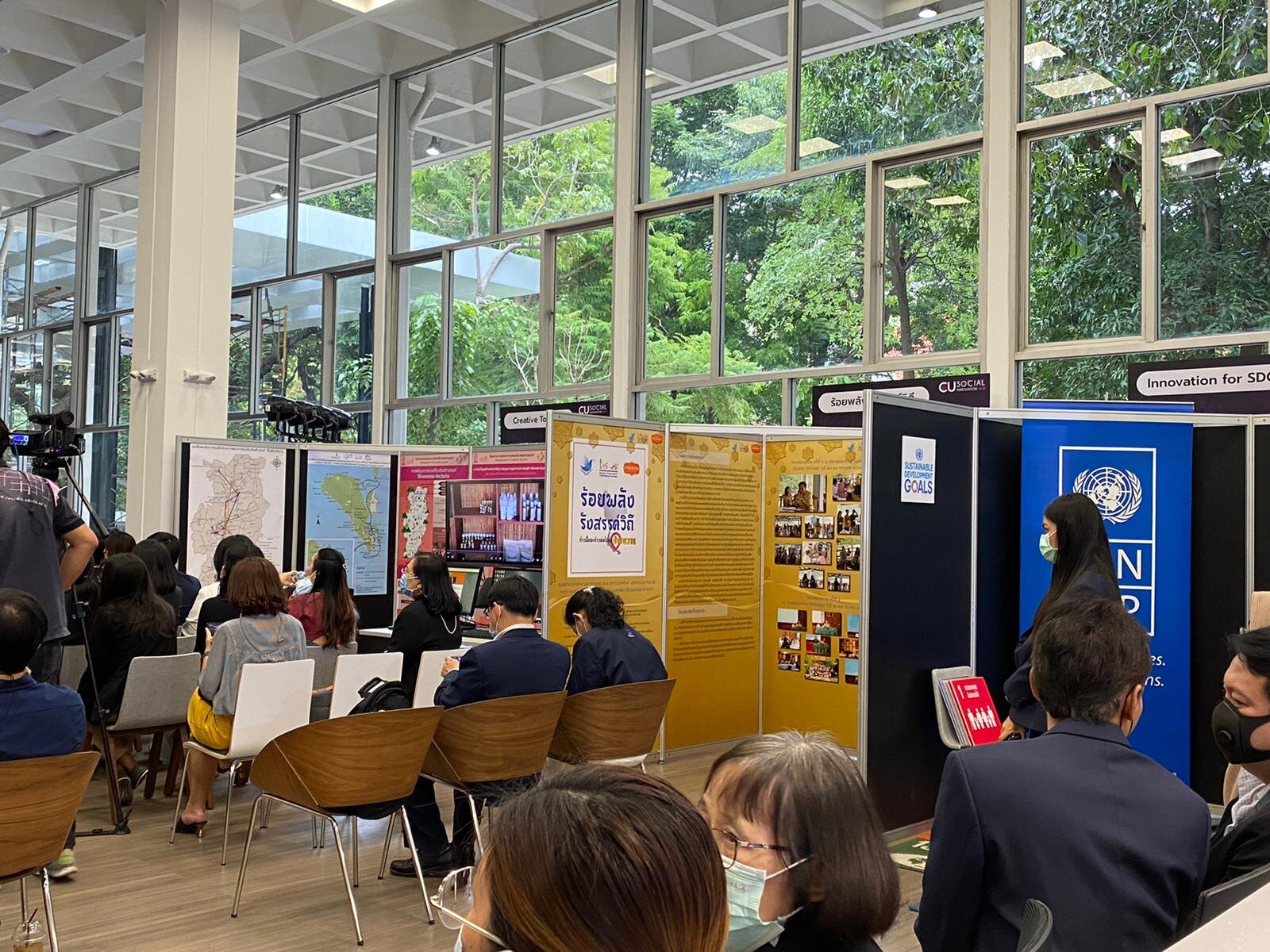
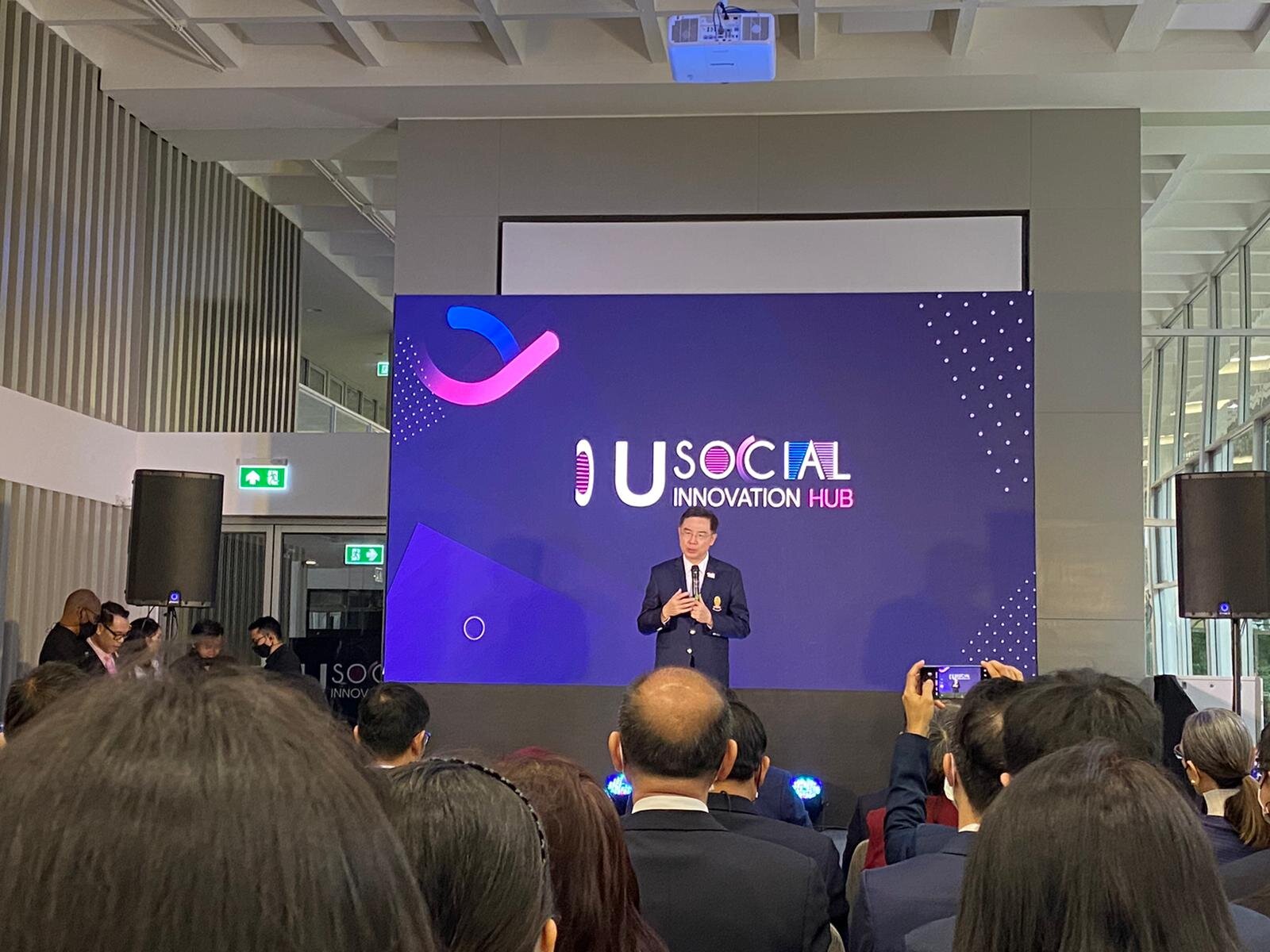
CSDS is hosting an exhibition booth at the Chulalongkorn University Social Innovation Hub for its Grand Opening Ceremony on 12 November 2020.
Displayed in the CSDS' exhibition booth is various information about the Center, including:

An online game titled "Exploring Reciprocity in Water Governance: A Role Play Game in Riverbank City", where audience will play as a trusted advisor of Riverbank City's governor, where there is a contested visions for development in the city and surrounding areas.
An introduction video about the CSDS, it’s mission, and our research from the perspective of the CSDS Committee Members (video here);
A video by the CSDS Director, Dr. Carl Middleton, explaining about CSDS's ongoing research on water diplomacy and water data democratization in the Mekong-Lancang basin.
Posters are also displayed explaining about CSDS's research on "Exploring Reciprocity as an Innovative Approach to Transboundary Water Governance in the Mekong-Lancang Basin" and "Innovating Institutions, Policy and Platforms for Water Data Democratization in the Mekong-Lancang River".
The exhibition for the CU Social Innovation Hub is located at the Visid Prachuabmoh Building, which is located on the Google Map here. The exhibition is open between 12 November 2020 to 25 November 2020 and is open for students and the public to visit.


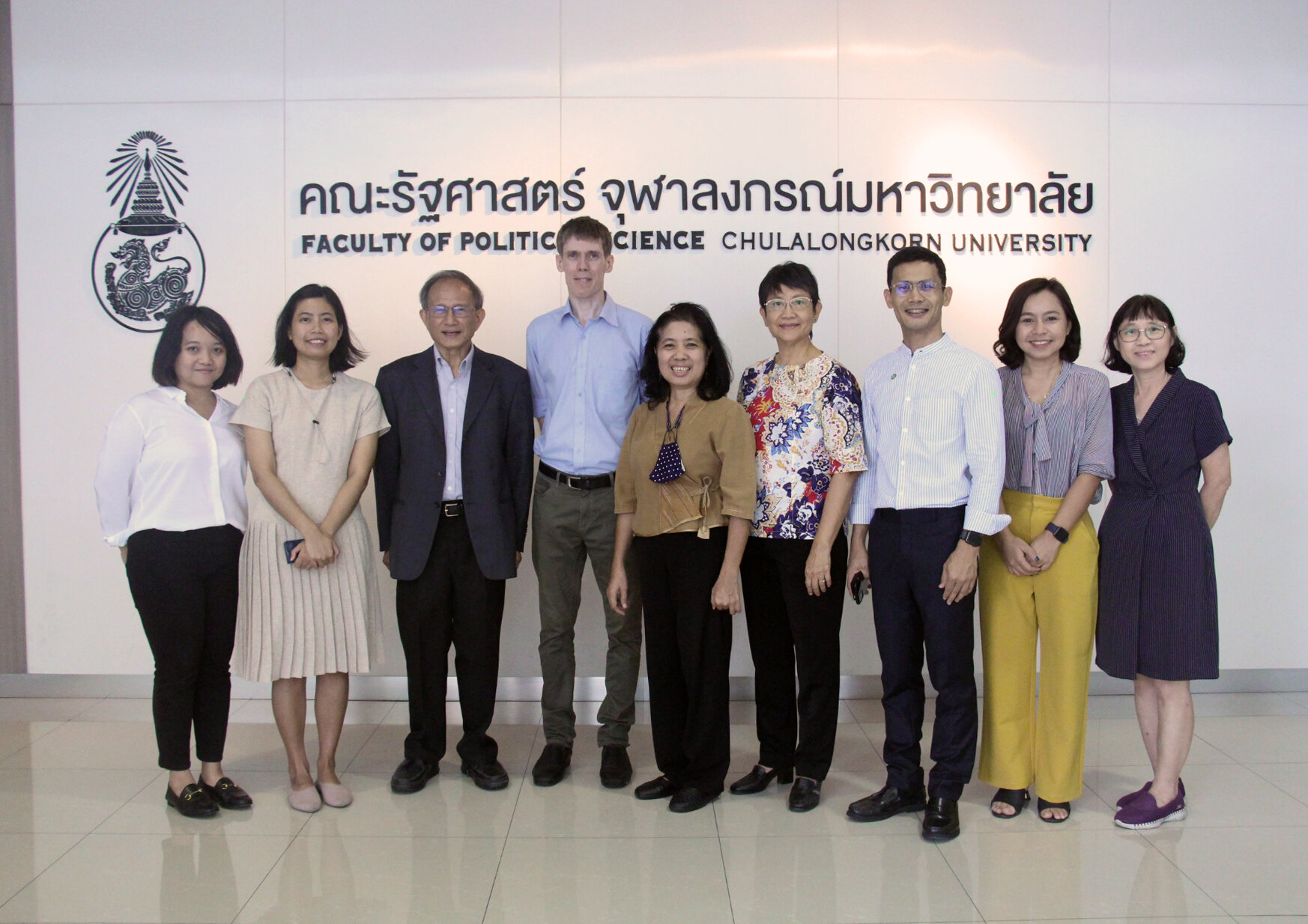
Today the Center of Excellence on Resource Politics for Social Development of the Center for Social Development Studies (CSDS), Faculty of Political Science received the “Center of Excellence (CE) with Outstanding Performance” award from Chulalongkorn University. This annual award is presented to recognize the research achievements of the researchers within the center and their research over the previous year.

Download our brochure here.
CSDS was established as a Research Unit within the Faculty of Political Science, Chulalongkorn University in 1985. It was established to undertake interdisciplinary research linking across the various fields of political science within the Faculty (government, public administration, international relations, and sociology and anthropology) and more broadly in the social sciences, and to provide support in education, research, and teaching. Starting from 2006, CSDS supported the launch of the MA in International Development Studies (MAIDS) program.
Since January 2018, CSDS launched the Chulalongkorn University Center of Excellence on Resource Politics for Social Development with the goal of undertaking interdisciplinary research for the purpose of understanding and seeking resolution to contested resource politics in Asia and supporting social development. The Center of Excellence focuses on five inter-related research sub-themes:
Starting this year, CSDS also announced a new theme on (Forced) Displacement and Development.
Our team are honored to receive this award and its recognition of our ongoing work. We will continue to work with our research partners in Thailand and the wider region towards equitable and just solutions on the region’s resource politics and in support of social development.
To get updated on our publications and events, please subscribe to our updates and newsletter here.

13.30-15.30, Tuesday, 27th October 2020 via Zoom
Carl Middleton from CSDS will be presenting on this event.
The Cambodian Institute for Cooperation and Peace (CICP) is going to organize a virtual conference on "Sustainable Development and the Future of the Mekong". For those participants who wish to attend in this virtual event, please complete the reply form in link here: http://bit.ly/FutureMekong
Panel IV: Human Security Issues in the Mekong Context: Agriculture, Energy, Water and Environment
The topics of rising energy demand, food and water security as well as environment have become increasingly salient in recent years and interact directly both at present and in future with the sustainability of the Mekong. Panelists from the Lower Mekong states, drawing on their particular areas of expertise, will address one or more of these human security issues and examine what policy frameworks can be developed in order to avoid humanitarian and development crises in the subregion.
Panelists:
Instigator: H.E. Amb. Pou Sothirak, CICP Executive Director
Dr. Mak Sithirith, Water Governance Specialist and Senior Research Fellow at CICP
Mr. Lê Trung Kiên, Senior Researcher, Institute for Foreign Policy and Strategic Studies, Diplomatic Academy of Vietnam
Dr. Han Phoumin, Senior Energy Economist, Economic Research Institute for ASEAN and East Asia, Jakarta
Ms. Solinn Lim, Country Director, Oxfam Cambodia
Dr. Carl Middleton, Deputy Director, Center for Social Development Studies, Chulalongkorn University, Thailand
Carl’s presentation will be on ”Water data democratization in the Mekong-Lancang basin”. For more information about this event, please visit the organizer’s webpage here.
View the full newsletter on this link.
22-25 September 2020 , Virtual Conference at https://event.pollen2020.exordo.com/

Abstract for: Demarcating the public and private in hydropower in the Mekong Region
By Carl Middleton*
In this paper, I critically analyze the generation of plural demarcations of 'public' and 'private' through large hydropower projects in the Mekong region. Different conceptual and material meanings of public are considered, including the public sphere, the public interest, public goods, public knowledge, and various 'publics' as group identity, and in each instance how they relate to – or merge with – notions of private. I show that the meaning of public and private is contextual, relational, and often hybrid rather than distinct, for example regarding: the corporatization of state-owned enterprises; the construction and operation of large dams as various types of public-private partnerships; the merging of public and private sources of finance; and in the definition and legitimation of resource and property rights. These plural meanings of public and private hold consequences for water governance that requires critical problematization, including in relation to: the configurations of state and non-state actors and their power relations that shape how collective and individual interests are defined and acted upon; the types of knowledge that are generated, by who, and for what purpose; the spaces/ places within which projects, plans and policies are discussed, contested and governed; and how benefits, costs and risks are ultimately distributed amongst different groups within society. The paper will present case studies from large hydropower projects within the Lancang-Mekong basin, analyzed in the context of partially-fulfilled plans for economic regionalization and cross-border electricity trade.
* Center of Excellence on Resource Politics for Social Development, Center for Social Development Studies, Faculty of Political Science, Chulalongkorn University (Carl.Chulalongkorn@gmail.com)
This paper will be presented as a pre-recorded presentation. View more details on the conference here: https://pollen2020.wordpress.com/.

09.00-16.00, Wednesday, 26th August 2020 at Meeting Room 801 (Floor 8th), Chaloem Rajakumari 60 Building (Chamchuri 10), Chulalongkorn University, Bangkok, Thailand
Carl Middleton from CSDS will be presenting on this event.
Strategic management, Chief Transformation and Strategic Office (CTS) is inviting Chula staff to join the 2nd CU SDGs Platform Forum on “Chulalongkorn University in partnership of driving sustainability: the future of the Post-COVID-19” with the aim to develop CU SDGs Platform, an open mechanism for building a network of people working on Sustainable Develo0pment Goals (SDGs), which is the starting point for further collaboration in the future of the Chulalongkorn community.
Carl will present on “The Political Ecology of Public Resources and Competition : The Future Challenges".
For those who interested please register online within 24th August 2020 via QR Code or https://qrgo.page.link/7o9FV
For further information, please contact Strategic management, Chief Transformation and Strategic Office (CTS). Tel: 02-218-0461
For the full schedule, please see below:

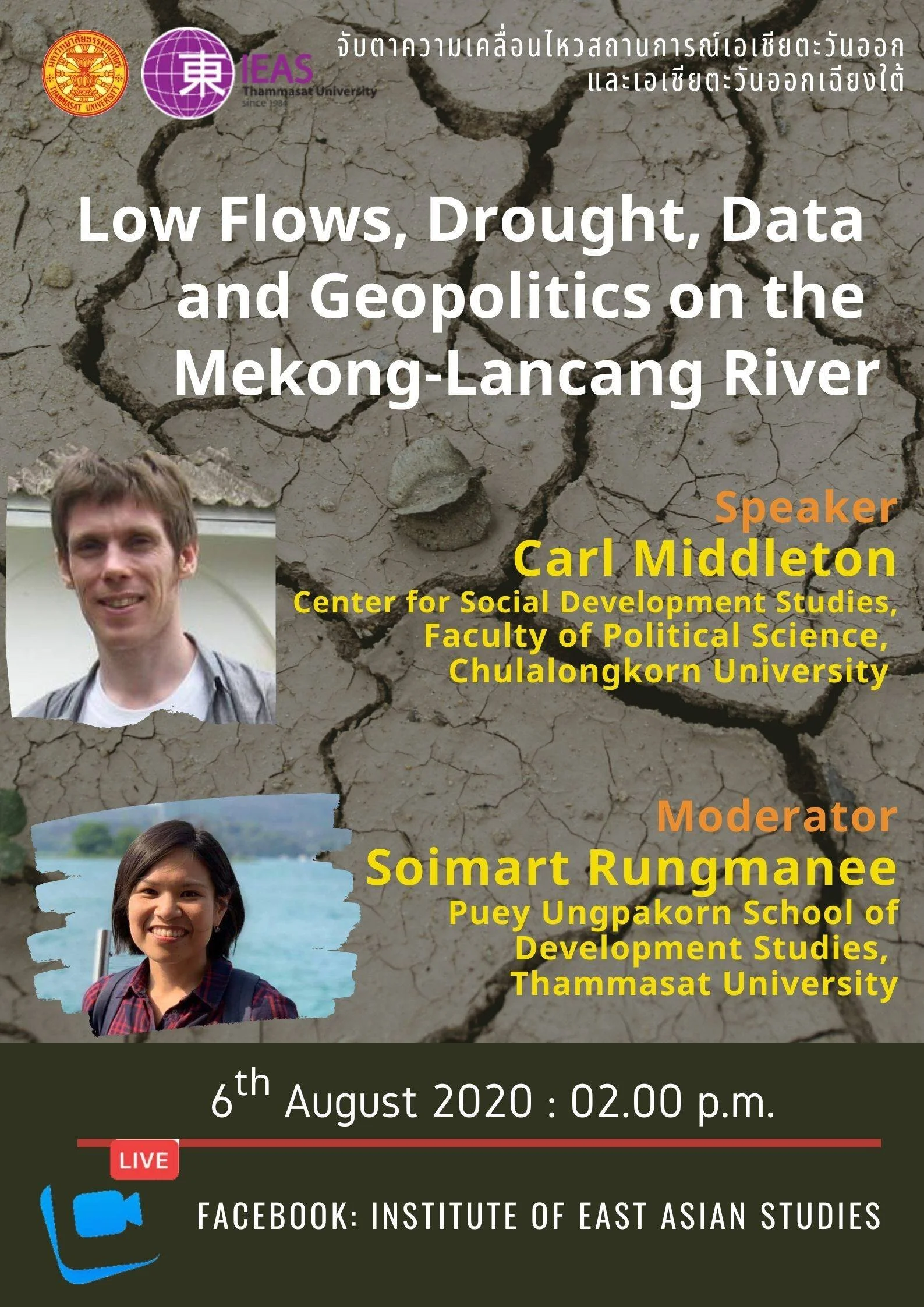
14.00-16.00, Thursday, 6th August 2020 at Institute of East Asian Studies, Thammasat University Facebook Page
Carl Middleton from CSDS will be presenting on this event.
Institute of East Asian Studies, Thammasat University, invites everyone to listen to a talk via online media (Facebook Live) to keep an eye on the movement of the situation of East Asia and Southeast Asia on the issue.
Speaker:
Asst. Prof. Dr. Carl Middleton
Center for Social Development Studies, Faculty of Political Science, Chulalongkorn University
Moderator:
Asst. Prof. Dr. Soimart Rungmanee from Puey Ungpakorn Institute of Development Studies, Thammasat University
For more information about this event, please visit the event page here.

Public Session organized for the International Conference on New research in international development, human rights, and international relations at a time of disruption
Institute of Asian Studies and Center of Excellence in Resource Politics for Social Development, Chulalongkorn University
Thursday 30 July 2020, start from 09:00-10:45 GMT+7/Thailand Time
Speakers:
“COVID-19: Risks of Lives and Emerging of Social Movement of Migrant Workers in Chiang Rai Borderland” by Suebsakul Kidnukorn, Area-based Social Innovation Research Center (Ab-SIRC), Mae Fah Luang University [Read Abstract]
“Tamsang-Tamsong: Social Distancing Promotion and Job Security for Motorcycle Taxi and Food Vendors during the Covid-19 Crisis” by Akkanut Wantanasombut, Mekong Studies Center, Institute of Asian Studies, Chulalongkorn University [Read Abstract]
“Rethinking the Future of Thai Fisheries: COVID-19 and Vulnerable Groups in Thai Fisheries Sector” by Nithis Thammaseangadipa, Asian Research Center for Migration, Institute of Asian Studies, Chulalongkorn University [Read Abstract]
“COVID- 19, Civil Society in Thailand’s Deep South and the Weak State” by Alisa Hasamoh, Faculty of Humanities and Social Development, Prince of Songkla University [Read Abstract]
Moderator: Naruemon Thabchumpon, Institute of Asian Studies and Center for Social Development Studies, Chulalongkorn University
This panel will be an online panel discussion hosted via Zoom and you can join by clicking on the link below:
You can also join using the details below:
Meeting ID: 916 1843 6974
Password: 166390
For any inquiries about this event, please contact Anisa Widyasari at communications.csds@gmail.com.

Public Session organized for the International Conference on New research in international development, human rights, and international relations at a time of disruption
Organized by the Center for Social Development Studies (CSDS) as part of the Political Ecology in Asia Seminar Series.
Wednesday 29 July 2020, start from 13:00-14:30 GMT+7/Thailand Time
Over the past couple of decades, various sources of air pollution have become major issues of public concern in Southeast Asia and risen to the highest levels of public policy and politics. For example, annual forest fires were especially severe in Northern Thailand this year and raised tensions between vocal urban residents and rural ethnic communities who are regularly blamed due to their use of fire in agricultural practices. Yet, the latter have tried to demonstrate that they themselves are some of the most severely affected and, far from being to blame, are actually at the front line of trying to manage the wildfires risking their lives in the process. Meanwhile, transboundary haze linked to burning peatlands in palm oil plantations in Indonesia causes harm – and frustration - in Singapore and Malaysia, also stoking inter-governmental tensions and blame games even as at least part of the responsibility links back to transnational companies based in Singapore and Malaysia. Also significant across the region is air pollution in expanding major and secondary urban areas produced by vehicles and other economic activities within them, including in Bangkok, Manila, Jakarta, Vientiane, Hanoi and Ho Chi Minh City. Whilst it is commonly narrated that urban air pollution affects all residents, in practice there is a strong social justice dimension as those who work outdoors– such as motorcycle taxi riders or street vendors – are significantly more exposed and with less resources to protect their health. The recent pandemic, and resultant lockdowns, resulted in some respite for the typically harmful pollution even as it is only temporary, and at great cost to livelihoods in general. Within these heated public discussions, many types of knowledge are produced and circulated influencing contesting discourses – including scientific studies, monitoring apps, media analysis, and community knowledge. Whilst a range of divergent solutions are regularly proposed by government agencies, politicians, academics, civil society, and community leaders, year after year air pollution continues to remain a challenge.
In this our first Political Ecology in Asia Seminar, coinciding with the International Conference on New Research in International Development, Human Rights, and International Relations at a Time of Disruption, we focus on the issue of social justice and air pollution. The discussion will examine how various economic, social and political inequalities intersect in relation to air pollution in terms of its creation and exposure, and the consequences for individuals, families and society as-a-whole. We situate the seminar in relation to the past experiences of air pollution and the heated debates that have ensued, but also look to the future given that the COVID-19 pandemic is disrupting and has the possibility to transform many aspects of future society-environment relations.
Speakers:
Daniel Hayward, Regional Centre for Social Science and Sustainable Development, Chiang Mai University
Dr. Helena Varkkey, Department of Strategic and International Studies, University of Malaya
Benjamin Tay, PM Haze
Tara Buakamsri, Greenpeace Southeast Asia
Chair: Asst. Prof. Dr. Carl Middleton, Center for Social Development Studies, Faculty of Political Science, Chulalongkorn University
This panel will be an online panel discussion hosted via Zoom and you can join by clicking on the link below:
You can also join using the details below:
Meeting ID: 988 1750 8760
Password: 418715
For any inquiries about this event, please contact Anisa Widyasari at communications.csds@gmail.com.
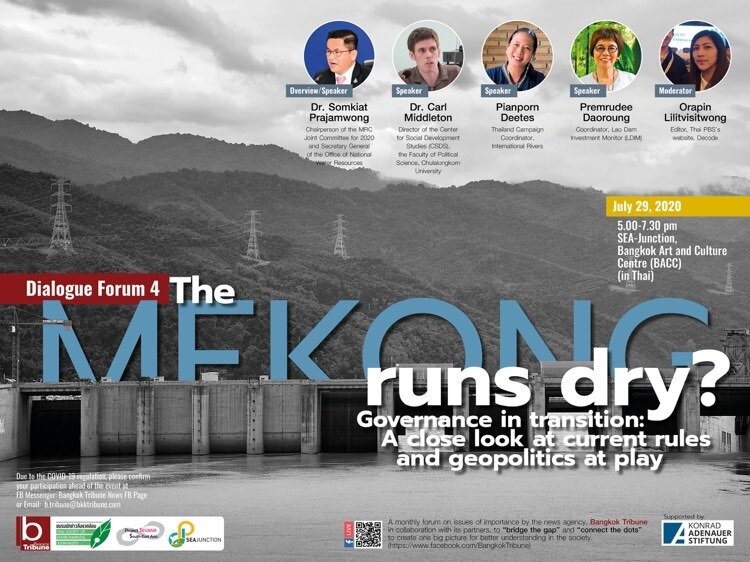
17.00 - 19.30, Wednesday, 29th july 2020 at the SEA-Junction, 4th Floor, Bangkok Art and Culture Centre
Carl Middleton from CSDS will be presenting on this event.
Development in the Mekong region, especially development trends and projects on the mainstream Mekong River itself, has long been a critical challenge and complicated issue for concerned parties and the public at large, and needs much understanding so that people can help one another find the way to share resources and live together in harmony. The attempt was first challenged since China started to develop the upper part of the river by building a cascade of dams on the river in early 1990s.
The challenge has become far critical especially in regard to the aspect concerning transboundary impacts as the Mekong countries become ambitious too and wish to build a cascade of dams, 11 so far, on the lower part of the river. At this point, they have been more than half way, as the sixth dam project, Sanakham, is subject to the regional prior consultation process, The question is; in times when development of the river has accelerated and posed a more serious threat, whether existing mechanisms to regulate water uses and mitigate impacts are efficient enough and catch up with such the speeding trend, and more critically, whether geopolitics in the region is still much at play and influences decisions made in regard to development in the region.
List of expert panelists:
Dr.Somkiat Prajamwong, Chairperson of the MRC Joint Committee for 2020 and Secretary General of the Office of National Water Resources
Dr. Carl Middleton, Director of the Center for Social Development Studies (CSDS), the Faculty of Political Science, Chulalongkorn University
Pianporn Deetes, Thailand Campaign Coordinator, International Rivers
Premrudee Daoroung, Coordinator, Lao Dam Investment Monitor (LDIM)
Orapin Lilitvisitwong, Editor, Thai PBS’s website, Decode
In accordance with the COVID-19 regulation, please confirm your participation ahead of the event (limited seats available). You can confirm your participation through Bangkok Tribune News FB Messenger here.
You can also watch the event live at FB Live: Bangkok Tribune News FB Page.
For more information, please visit the event’s website here.
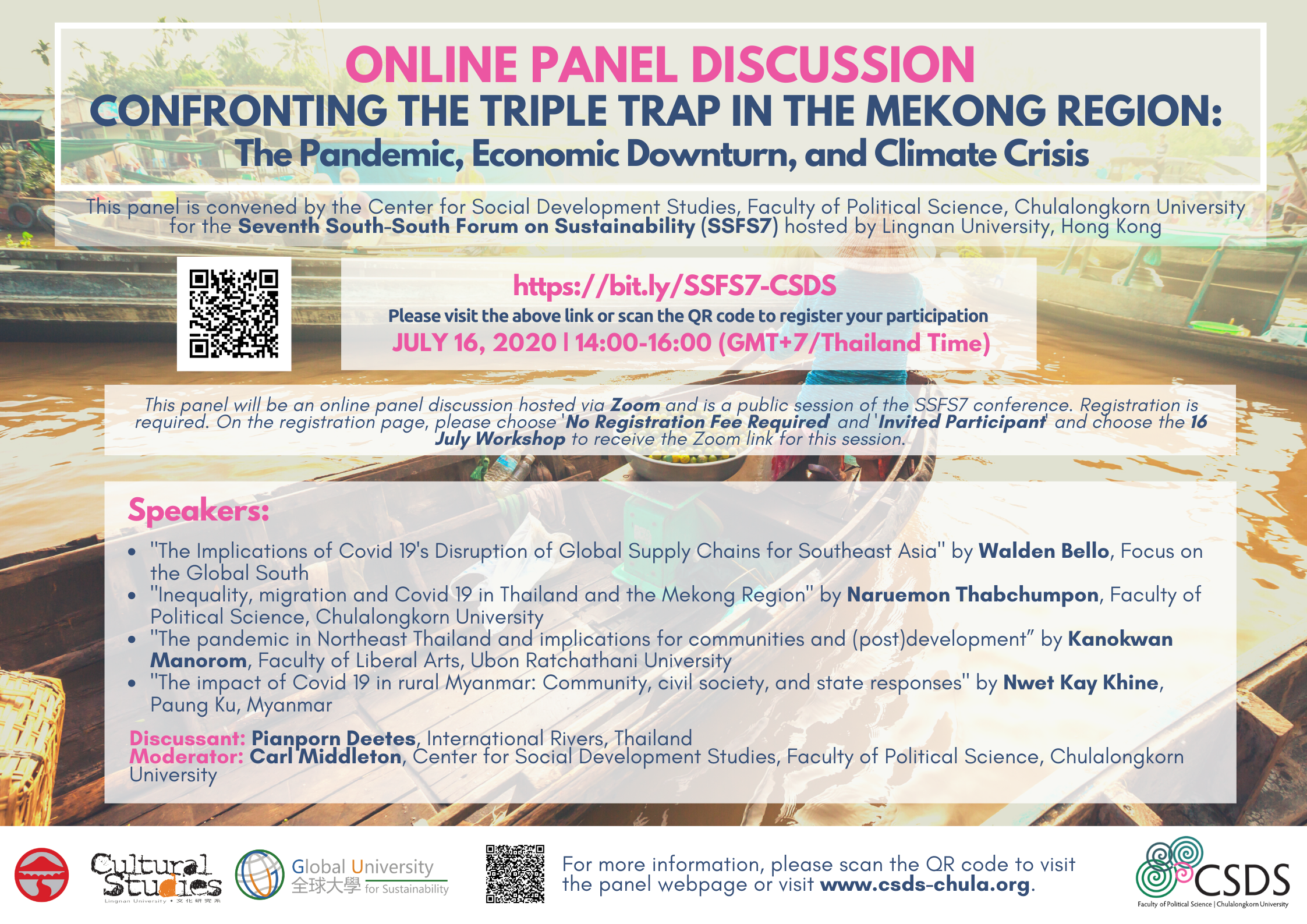
This panel is convened by the Center for Social Development Studies, Faculty of Political Science, Chulalongkorn University for the Seventh South-South Forum on Sustainability (SSFS7) hosted by Lingnan University, Hong Kong.
Thursday 16 July 2020, start from 14:00-16:00 GMT+7/Thailand Time
In this session, we will discuss how the ‘triple trap’ - the pandemic, economic downturn, and climate crisis – have affected communities across the Mekong region, and how these challenges have been responded to by them, as well as by civil society and state. We also examine the long-term implications of the triple trap, asking what transformations have already occurred and what could happen in the future.
Speakers:
"The Implications of Covid 19's Disruption of Global Supply Chains for Southeast Asia" by Walden Bello, Focus on the Global South
"Inequality, migration and Covid 19 in Thailand and the Mekong Region" by Naruemon Thabchumpon, Faculty of Political Science, Chulalongkorn University
"The pandemic in Northeast Thailand and implications for communities and (post)development” by Kanokwan Manorom, Faculty of Liberal Arts, Ubon Ratchathani University
"The impact of Covid 19 in rural Myanmar: Community, civil society, and state responses" by Nwet Kay Khine, Paung Ku, Myanmar
Discussant: Pianporn Deetes, International Rivers, Thailand
Moderator: Carl Middleton, Center for Social Development Studies, Faculty of Political Science, Chulalongkorn University
This panel will be an online panel discussion hosted via Zoom and is a public session of the SSFS7 conference. Registration is required on the link below:
On the registration page, please choose 'No Registration Fee Required' and 'Invited Participant' and choose the ’16 July: Workshops on Venezuela, Mexico and Mekong Region‘ to receive the Zoom link for this session.
For more information about this conference, please visit the conference website here.

View the full newsletter on this link.

Routledge is currently having promotion - which allows seven days of free access between now and the 14th of June to monograph eBooks. After the trial, those who have signed up for the free access can choose to purchase the eBook at the special price of £10 / $15.
One of CSDS’ books, Living with Floods in a Mobile Southeast Asia: Vulnerability, Migration and Environmental Change, is part of this promotion. This book contributes to a better understanding of the relationship between migration, vulnerability, resilience and social justice associated with flooding across diverse environmental, social and policy contexts in Southeast Asia. It challenges simple analyses of flooding as a singular driver of migration, and instead considers the ways in which floods figure in migration-based livelihoods and amongst already mobile populations.
You can access the book in this link here.
Our affiliate taught program, MA in International Development Studies, Faculty of Political Science, Chulalongkorn University (MAIDS-Chula), is organizing an international virtual conference on “New research in international development, human rights, and international relations at a time of disruption” , which will be held on 27 July 2020.

The challenge of the COVID-19 pandemic since early 2020 has brought widespread harm across societies in Asia and globally. Amidst acts of solidarity, the pandemic has placed into intense focus the consequences of inequality, the resilience of social welfare systems, and the responsibilities of governments as well as society at large. It has also led to a critical scrutiny of the current economic system together with the relationship between people and nature. Thus, this ‘time of disruption’ has intersected with existing issues in international development, human rights and international relations.
For more information, please visit the conference webpage here.
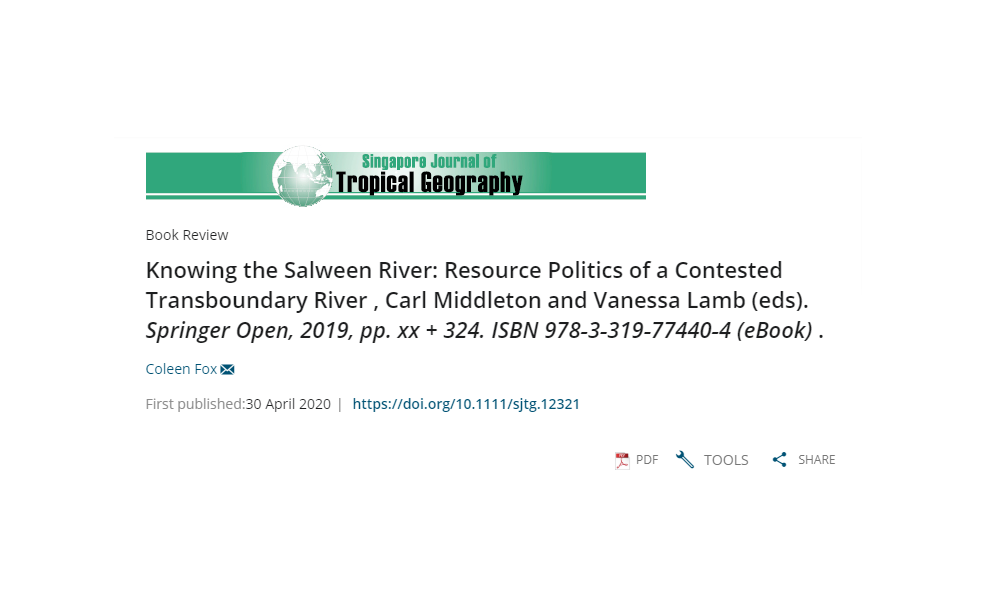
By Coleen Fox [Singapore Journal of Tropical Geography]
In the last chapter of Knowing the Salween River, Nang Shining, a Shan woman living and working near the site of a proposed dam in Myanmar, writes of the frustration that communities feel when they are not consulted about projects affecting their lives and livelihoods. She discusses her efforts to create networks of young people across borders and basins, which is part of an effort to bring more voices to the decision-making process in the pursuit of social justice and sustainable development. Nang Shining’s story captures well the tensions that characterize resource politics in the Salween—while powerful national and regional actors push development and exclude local communities from meaningful participation, those same communities, supported by academics and civil society, work tirelessly to have their concerns acknowledged.
Knowing the Salween River sheds light on exactly these sorts of dynamics, revealing the multiple ways that institutions, academics, communities, and civil society organizations research and understand the river basin.
***
Read the full review here.
Carl Middleton of CSDS is co-editor and co-author of this book (see here)
Get the book: Knowing the Salween River: Resource Politics of a Contested Transboundary River (Springer Open, 2019)