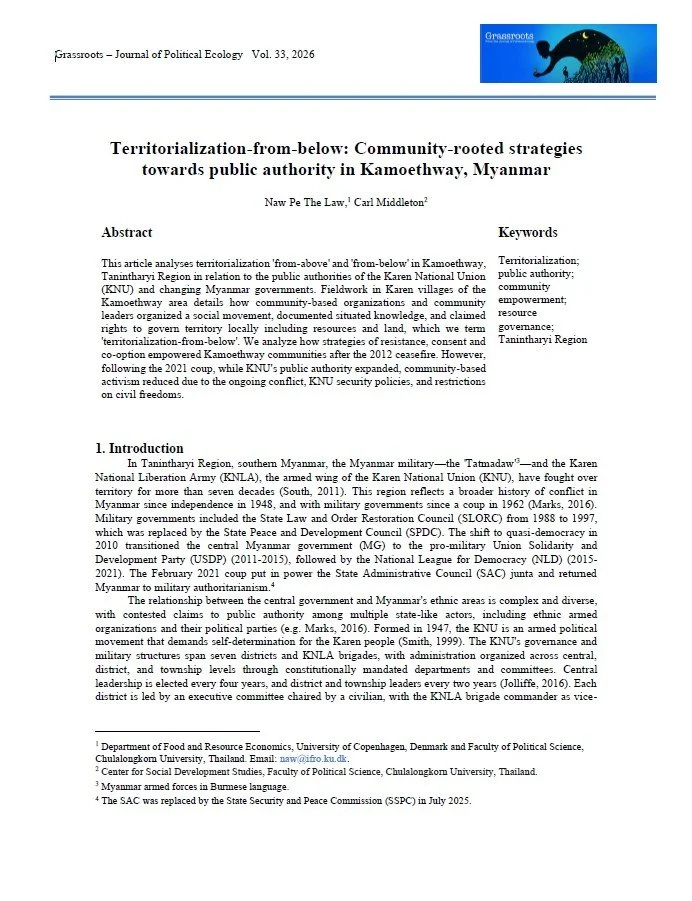
Territorialization-from-below: Community-rooted strategies towards public authority in Kamoethway, Myanmar


Publication date:19th June 2026

Authors: Naw Pe The Law, Carl Middleton

Further details on the article, visit the journal at: https://journals.librarypublishing.arizona.edu/jpe/article/id/8618/

Abstract:

This article analyses territorialization 'from-above' and 'from-below' in Kamoethway, Tanintharyi Region in relation to the public authorities of the Karen National Union (KNU) and changing Myanmar governments. Fieldwork in Karen villages of the Kamoethway area details how community-based organizations and community leaders organized a social movement, documented situated knowledge, and claimed rights to govern territory locally including resources and land, which we term 'territorialization-from-below'. We analyze how strategies of resistance, consent and co-option empowered Kamoethway communities after the 2012 ceasefire. However, following the 2021 coup, while KNU's public authority expanded, community-based activism reduced due to the ongoing conflict, KNU security policies, and restrictions on civil freedoms.

Read the full article here.
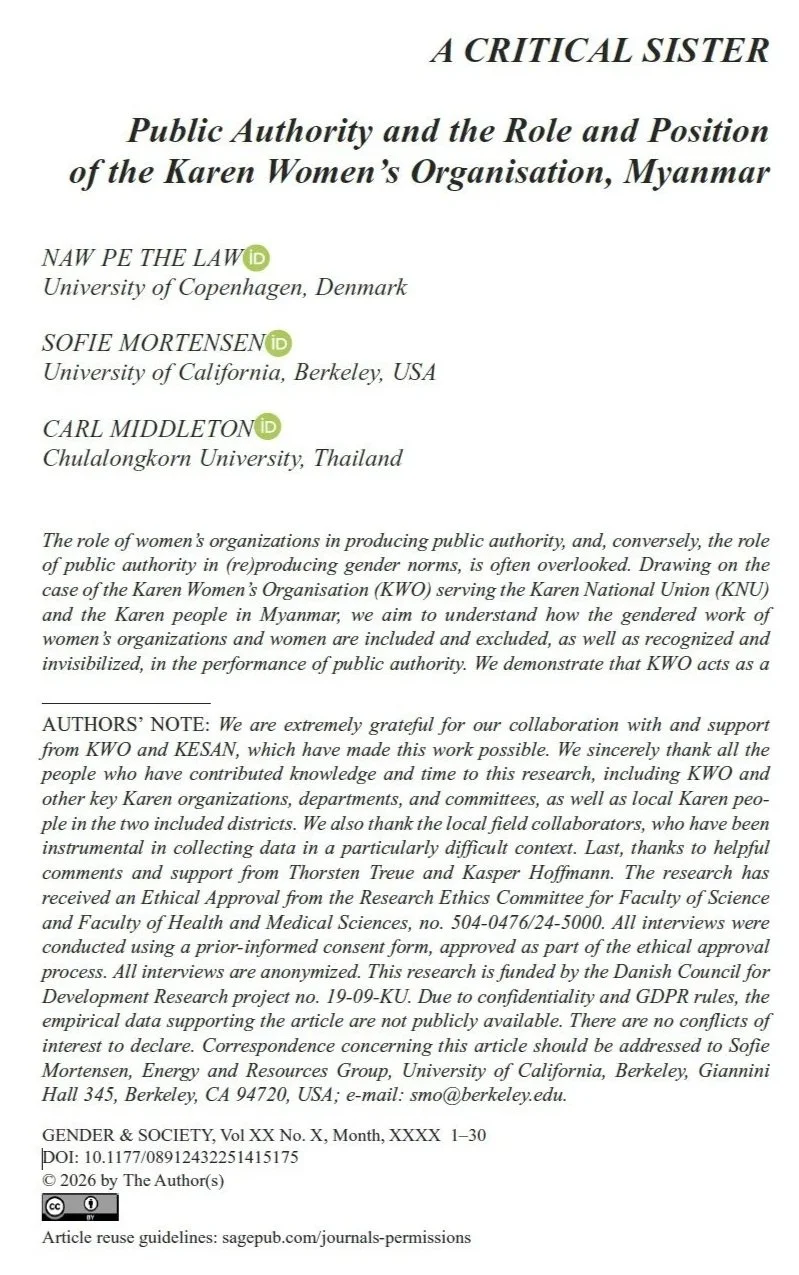
JOURNAL ARTICLE: "A Critical Sister: Public Authority and the Role and Position of the Karen Women’s Organisation, Myanmar"

Publication date:
11 February 2026

Authors: Naw Pe The Law, Sofie Mortensen and Carl Middleton

Further details on the article, visit the journal A Critical Sister: Public Authority and the Role and Position of the Karen Women’s Organisation, Myanmar.

The role of women’s organizations in producing public authority, and, conversely, the role of public authority in (re)producing gender norms, is often overlooked. Drawing on the case of the Karen Women’s Organisation (KWO) serving the Karen National Union (KNU) and the Karen people in Myanmar, we aim to understand how the gendered work of women’s organizations and women are included and excluded, as well as recognized and invisibilized, in the performance of public authority. We demonstrate that KWO acts as a critical sister, playing a vital role in co-producing KNU’s legitimacy through public service provision and revolutionary support, while simultaneously walking a fine line by criticizing the dominant patriarchal norms. At the same time, reflecting wider societal gender power structures, KWO’s work is often invisibilized in a male-dominated organization, and women remain excluded from key areas of public authority, including high-level decision-making and land and forest governance. We argue that these exclusions and invisibilizations reproduce masculine domination in the exercise of public authority and affect gender inequality in Karen society. Such findings underscore the importance of acknowledging the significant contributions of women’s organizations in producing public authority to challenge patriarchal norms and to more firmly center gender within future research on public authority.

Read the full article here.

POLICY BRIEF: “Recognizing and Promoting KWO and Women’s Decision-making in KNU’s 2025 Transition to Government”

Publication date: March 2025

Publication: University of Copenhagen; Chulalongkorn University; Karen Environment and Social Action Network (KESAN); and Karen Women’s Organization (KWO)

Authors: Naw Pe The Law and Sofie Mortensen

Download the policy brief in English, Burmese and Karen.


This policy brief highlights key contributions of the Karen Women’s Organization (KWO) in supporting the Karen National Union’s (KNU) internal and external legitimacy, including on: public service delivery, capacity strengthening and promotion of gender-equal institutions. It identifies key challenges and makes recommendations to the KNU and KWO, namely: Lack of an official women’s voice and invisibilization of support; Biased voting system and lack of trust in women’s capacity to make decisions and lead; and Gendered divisions of labor and exclusions from key areas of governance. 

Citation: Naw Pe The Law and Mortensen, S. (2025) Recognizing and Promoting KWO and Women’s Decision-making in KNU’s 2025 Transition to Government. University of Copenhagen; Chulalongkorn University; Karen Environment and Social Action Network (KESAN); and Karen Women’s Organization (KWO).